Showing posts with label North Dakota. Show all posts

Tuesday, July 12, 2022

Clan William: Capt David Minard, MC, USN, MD

Capt David Minard, MC USN MD
Yesterday, we talked about Gladys (a Munson descendant) and Archibald Ellison Minard. Today, the
subject is one of their sons, Captain David Minard, MC USN MD. 

Capt Thomas Munson > Samuel Munson > Samuel James Munson > William Munson > Martha Munson > Rueben Doolittle > James Rood Doolittle > Sara Lovinia Doolittle > Gladys May Pease m. Archibald Ellsworth Minard > David Minard

David Minard was born 23  May 1913 in Fargo, North Dakota, where his father was a professor at nearby North Dakota Agricultural College. Minard grew up in Fargo, then attended college at the University of Chicago with a PhD in Physiology in 1937. He received his medical degree at UoC in 1943 and joined the US Navy (MC) as a physician. In 1954, he completed a master's in public health from Harvard University (his father's alma mater).

David served in the military from 1943 until 1963, attaining the rank of Captain (0-6). During the war, he was assigned to various command assignments such as Flagship 67/Division 23 and Group 10 staff on temporary duty as part of medical staff. 

Beginning in 1946, David headed the physiology department at the Naval Medical Research Center in Bethesda, MD. David met and married Sarah Prince "Sally" Zimmerman and their first child, a son, arrived in 1949; two more boys and a girl would follow before 1956. During the 1950s, he'd attained the rank of Captain.  In 1957, along with Constantin Yaglou, he developed a wet globe termperature index for Marines training at Parris Island, South Carolina. This had applications beyond the military - steel plants, in foot racing, and industrial environments, where humans were exposed to high temperatures.

Mercury 7 Astronauts
In 1960, David used the Index to evaluate the astronauts of Mercury 7, the.first manned space flights in the United States.  The program, started in 1958, ended with six manned flights between 1961 and 1963. 

David's most newsworthy research occurred in 1962 when the news of the experiments hit the newspapers across the country.  The research involved taking a group of 98 sailors and two officers and medical personnel into a 25x48 concrete shelter built on the grounds of the Research Center at Bethesda. They stayed in the shelter for 14 consecutive days. The purpose was to test psychological, physical, and physiological effects of long stays in such environments. 

The experiment included TV cameras which could continually monitor everything that happened during the process. Two individuals would exit the shelter on a daily basis to take Geiger and other readings. And, while being equipped with electricity there was no heat other than body heat. Food was provided at 2,000 calories each day. There was no real recreation other than books and magazines. 

For their part, the sailors, from the US Naval Training Center at Great Lakes, Illinois, each received a 72-hour pass after their release from the shelter and follow-on testing. David called it a "great success."

Capt Minard about to enter
fallout shelter saying goodbye
to his family
In 1963, David left the military and moved on as a Professor at the University of Pittsburgh Graduate
School of Public Health. He was named Professor Emeritus in 1974. 

David and his wife Sally divorced. Son Nicholas, aged 21 died in Pittsburgh in 1975. At about the same time, David remarried, this time to Dorotha J Rittenhouse Fallong, mother of two.

Sally went on to marry Walter Limbach. She lived to the ripe age of 90, dying in 2014. After her divorce from David, she worked as a family therapist working with women who survived domestic abuse at the Women's Center and Shelter of Greater Pittsburgh. 

David went back to clinical work at US Steel and at the Easton Memorial Hospital in Easton, Maryland. He finally retired in 1980. On 09 Oct 2005 after a stroke, in Cambridge, Maryland. His wife Dorotha died in 2012.

Monday, July 11, 2022

Clan William: Gladys Pease and Archibald Ellsworth Minard

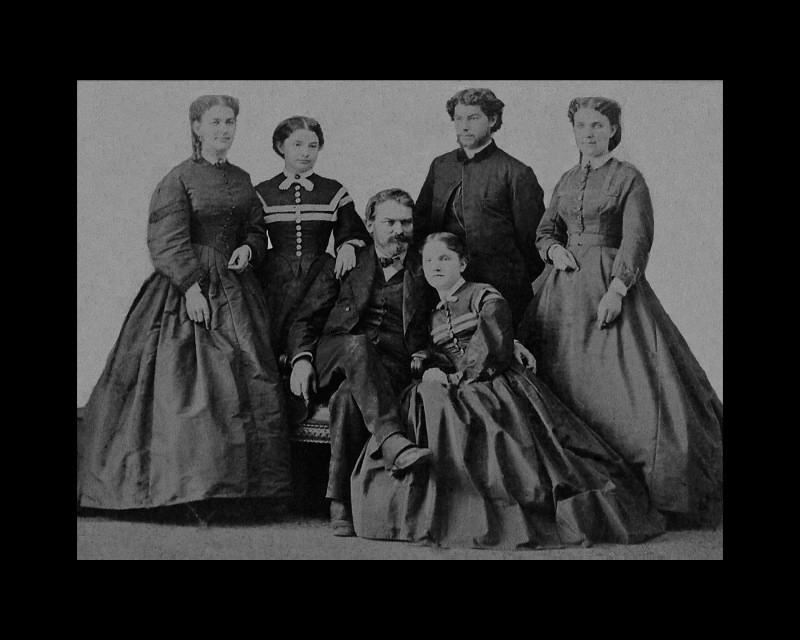
Sen. James Rood Doolittle with
children (Sara seated)
Those Munson women seemed to attach themselves to some high-achieving men. In this case, Gladys
connected herself to Archibald Ellsworth Minard, a Harvard graduate who would travel west to North Dakota. The Clan William connections is as listed:

Capt Thomas Munson > Samuel Munson > Samuel James Munson > William Munson > Martha Munson > Rueben Doolittle > James Rood Doolittle > Sara Lovinia Doolittle > Gladys May Pease m. Archibald Ellsworth Minard

Gladys came from "good stock." Her grandfather was Senator James Rood Doolittle, an attorney, who had hailed from Hampton, Washington County, New York. He had relocated to Racine, Wisconsin in 1851 where he was elected judge of the first judicial circuit in 1853 and then in 1857 began serving two terms as a US Senator. He later was a professor of law at Chicago University and was a trustee of same.

The marriage of her father, Edwin Hatfield Pease and mother, Sara Doolittle, was the social event of the year in Racine in 1879. Edwin had served as a private in the Civil War in Company F of the Illinois 93rd Infantry Regiment. A manufacturer/businessman of good repute in Racine, he died of complications of the flu/pneumonia at age 49 in 1890. Gladys was the fourth of the five children, born in 1887.

Archibald Ellsworth Minard
Sara Doolittle Pease married John Adams Prindle, a widower with five surviving children in 1895. In 1900, the family moved to Springvale, Stark, North Dakota to pioneer. Sadly, John died in 1907 in Fargo, North Dakota.  In 1910, Sara relocated to the Sioux City, Iowa area and lived with her son the veterinarian, Edward Pease, for a few months, then she moved in with son H. T. Pease in Deer Park, Washington, where she died on 27 Jul 1911.

Daughter Gladys had made a "good marriage" with Archibald Ellsworth Minard, a native of Novia Scotia born in 1878, who had emigrated to the US when he was 11 years old.  Archibald received his degrees from Harvard and became a professor of English and Philosophy at North Dakota Agricultural College (now North Dakota State University). The couple had married in 1908 and proceeded to have four children; two boys and two girls. 

Professor Minard served as interim president for three months in 1929, then became the Dean of the School for Applied Arts and Sciences the same year. He would hold that position until 1949. 

Gladys died in 1939 at the age of 48. She had just seen her daughter Lois married in 1936 and son Edwin in 1938. 

Archibald remarried in 1941 to a widow with two grown children, Elita Gustava Olson McArdle. 

One of the noteworthy things that Archibald did while at NDAC, was to write the school song, the lyrics of which are today, quite awful, but for the time, far less offensive:

...He wanted to incorporate the school colors, yellow and green, with North Dakota’s landscape and characteristics. Minard thought he could use his song as well for the State’s song. Minard wrote the lyrics and then took the song to Clarence Putnam, the head of the music department at the time. “The Yellow And The Green” did become the University's official school song, but it did make it as the state’s song as Minard would have hoped. Instead, Putnam wrote the music for what became the state's song in 1947 and used the lyrics from James W. Foley’s “The North Dakota Hymn.” There has been some controversy surrounding the school song. In the third stanza of the song, it speaks of the red man scavenging the land for scraps, while the white anglo saxons prevail and conquer the prairies...https://pocketsights.com/tours/place/Archibald-Minard-6511:809

In 1949, Minard retired as Dean, but continued to teach philosophy at the School. The former Science building, built in 1902 and which had a fourth floor added in 1919, was named after Minard in honor of his 46 years of service at NDAC. The fourth floor of the building was where dances were held. In 2011, the building collapsed in on itself and would not be revived until 2013. It is still in use.

Minard died on 09 May 1950 died at Bethesda Naval Hospital, where he had been hospitalized for four weeks. Son David lived nearby.

Minard Hall, former Science Hall at NDAC


Thursday, November 30, 2017

Things and Other Things that Are Coming Up with Love

What we work on, in our genealogical research, is discovering what the lives and loves of our ancestors were like in whatever small way we can, without a big book of family stories to read from. Filling in those blanks has brought me great pleasure this past three years. I've taken trips of exploration, interviewed distant relatives, researched parts of family I never knew I had, and met with others in my own far-flung family who share my interests in-person from time-to-time (shout out to my cousin in Clarksville!)

This past several months have been most busy. Hopefully making memories that won't be quite as hard to unearth for future generations.  I am blessed to be the mother of three children, all brought into my life and heart through adoption. They are all well-adjusted and amazing kids and I couldn't be more proud of them and their accomplishments thus far in life. They are all grown now and settling into adult lives of their own making. My oldest is married and has a two-year-old child of his own. To see him with her would warm the coldest of hearts. You can read a little bit about my youngest two's start in life here. They are doing far beyond early predictions. All three are the greatest joy of my life.

Recently, I've been trying to put together pieces of the family trees of all three of them. Fortunately, two will share the same information or it might have gotten a little crazy. In discussing doing the work on this with them, they, who have generally shown little or no interest in their biological families, are indeed most interesting in hearing about the people who came in generations before.

What I've discovered thus far is compelling and fascinating. The two stories are about as different as they could be from one another as it relates to the path of immigration, but each story is very rich. And, both stories end up in the north-central Midwest.

I don't have the resources with their research I've had with my own biological family. I can't ask a cousin to ask a cousin if I can come up and talk to them. Most of their relatives don't even know they exist. It could be a bit shocking to make those calls! They all had open adoptions, so talking to at least one birth parent is not a problem, but, what we find out from that adventure, we have yet to discover. It's one I'm looking forward to doing what I am able to do and providing it to my children to help them in their own quest for self-identity.


Monday, April 24, 2017

Vernard, Oh, Vernard, What Have You Done?

WILLIAM MILLER > MILO VOLNEY MILLER > ALMIRA MILLER > WESLEY BARTLETT FEE m Estella C Cox > VERNARD FEE m Zora Emma Robinson

I've talked a little about both Milo and Almira. Wesley Bartlett Fee went by "Bart" his entire adult life or "W. B." He farmed successfully, raising stock in both shorthorn cattle and American Poland-China hogs. The 1930s wouldn't be a stellar decade for Bart and his family. His farm was severely damaged by a windstorm, his son's wife would cause a scandal of epic proportions, and the same son would die under mysterious circumstances. Bart and his wife both died in 1934.

Kensal, ND, just a few miles from Corrine, where
the Fees homesteaded in the 1910s.
Vernard and Zora got married on 25 Nov 1914 in Delaware County, Iowa. Zora was born on 12 Sep 1895 in Earlville, Delaware County to Charles and Mary Simons Robinson. The young Fee couple had their first son, Charles, in 1915 in Iowa, but by 1917 had moved to Corinne, Stutsman, North Dakota, where their second son Clarence was born. Vernard had a bad case of pneumonia while there and by late 1920, they had returned to Iowa where he plied his trade as a cattle buyer and farmer, like his father. They had three more boys in short order back in Iowa.

Then, the weirdness begins!

On Tuesday, September 2, 1930, Mrs Fee and the five children, paid a "friend" to drive them to her sister's in Delaware County. The Fees had been bickering and fighting for some time and she needed a break. They never arrived. Police were called in and according to reports, "...were concerned over the disappearance of a razor and rat poison from the farm home of Vernard Fee, apparently about the time it was left by Mrs Fee and five children..."

Mrs Fee had only five dollars with her and no food. On September 18th, Mrs Fee and the children returned with quite a tale to tell:


Ralph Owens, who was her traveling companion, was eight years younger than Zora. He was born in Vinton, Iowa 11 Jul 1903. The 1930 census has him living with his parents. We'll get back to him.

The Fee's were headed to divorce. Their divorce was finally granted in about February 1932. Vernard was living at the time with his parents. He had been working in the shed at his parents' farm, soldering a pipe on a stove for the brooder on the evening of his death. He then went to a friends' home and was later found slumped in his car at his friends' home. The death had originally been attributed to self-administered poison, but the coroner found it to be accidental.


How long it took for Ralph Owens and Zora to end up cohabitating, I don't know, but by the 1940 census they were all living together on a rented farm in Harrison township. In 1942, they married. In 1947, Ralph died suddenly of a heart attack at age 43. Zora did not marry again and would die 02 Dec 1976 in a Cedar Rapids nursing home.

Monday, January 9, 2017

Dr George Monteith of North Dakota

ANDREW MONTEITH > WILLIAM BOYD MONTEITH > GEORGE MONTEITH, MD m Lucy I
Dr George Monteith
Hubbard

Dr. George Monteith was born 06 Apr 1887 in Adams, Green County, Wisconsin to William Boyd Monteith and Mary Anna Bleiler. After being educated in the country schools, he went on to university. He receive his medical degree from Marquette University in Wisconsin and after graduating, lived in Blanchardville, Wisconsin.

Lucy Hubbard was the daughter of Thomas and Priscilla Hubbard, born 17 Jan 1889. They originally hailed from the Rock Island area of Illinois, but had moved to near Marion in Linn County, Iowa, where Lucy was born. By 1900, they were living in Huron, Beadle, South Dakota. 1910 found them living in Cherry Grove, Emmons, North Dakota. After she completed her public school education, she taught in Hazleton in Emmons County.
Hazleton, 1913
"Hazelton, named in honor of Hazel Roop, daughter of Mr. and Mrs. J. L. Roop on whose farm the townsite was located, is situated 20 miles north of the geographical center of Emmons County, 15 miles east of the Missouri River and about 50 miles south and east of Bismarck. Located on the NEV4-30, 135-76 the townsite plat was recorded Nov. 19, 1902. The founding of Hazelton was tied up with the development of the railroad. Twenty years before the town was thought of, the trans-continental line of the Northern Pacific was completed. Almost from the beginning, the N. P. management was interested in the country south of McKenzie. Construction of the branch line south to Linton, however, was not started until June, 1902, and completed in October, 1903. On Nov. 5, 1903, the first trains began operating through Hazelton on a regular schedule. When the N. P. finally did come into Emmons County, the Hazelton site with its beauty of location and expanse of fertile farm land in every direction, marked this as the ideal one for a thriving town... From the date of its birth, Hazelton enjoyed a healthy growth and soon became an important market place....Hazelton, it appears, enjoyed its biggest boom during March, 1906, when 25 new families and 27 carloads of livestock and personal belongings moved into town, swelling the population to about 250 people. In Nov., 1907, J. I. Roop announced that another addition to the original townsite had been platted and that a number of desirable lots were available at reasonable prices. W. L. Yeater opened a new hotel in 1907 which was considered one of the most modern in the state. Another important event occured during November, 1907: Railway mail service was established between McKenzie and Linton, replacing service formerly offered by the stage line..."
(As written by Math Dahl for the Hazelton Jubilee in 1953)
Emmons County History, 1976
Hazleton, Main St Looking North, 1918
In 1911, Dr. Monteith moved to Hazleton and set up shop in March. The first office he had was on the second floor of the Klabunde Store. After 1913, Mr Semling and Mr Porter opened a drug store and provided space in their store for his offices.

On October 13, 1913, he married Lucy Hubbard.

During World War I he enlisted in the armed forces. He was commissioned a 1Lt in the Medical Corps and was assigned to Fort Riley, Kansas, then Ft Sill, Oklahoma. He was sent overseas in May of 1918 and was wounded (gassed) while serving in France. He returned to the US in Apr 1919. He was discharged 06 May 1919 at Camp Dodge, Iowa. He returned to Hazleton after his discharge and resumed his practice.

In 1927, Dr. Monteith was sued for malpractice when Farmer McDonnell injured his arm severely in a threshing machine and he had to go through months of pain and additional treatment. Dr. Monteith prevailed in the case.

Dr. Monteith would continue on as the town surgeon until 1950, when his health began to fail. In 1954, the family moved to Eugene, Lane County, Oregon where George died 26 Feb 1959 and Lucy died 02 Feb 1987.

The couple had five children: Thomas Cavott, Mary Louise, Muriel, George Jr., and Jane Elizabeth.