Monday, June 29, 2026

MUNSON TALES: Love, Abolition, Suffrage, and Frederick Douglass (Clan Ephraim) Part 2

Part 1 can be found here

The Civil War came and his sons Frederick, Lewis, and Charles all served in various capacities. Finally, the Emancipation Proclamation was issued in 1863 and all slaves were free, if in name only. Frederick, on the other hand, met with Abraham Lincoln in 1863 and 1864 on the treatment of black soldiers and how to mobilize the southern slaves in the war effort for the Union. Come the election of 1864, Douglass endorsed John C. Fremont as he was deeply disappointed in Lincoln for not moving fast or hard enough.

In 1865, the 13th, 14th, and 15th amendments were passed, changing everything for former slaves, but again, mostly in name only. They were free, but not really free at all.

During reconstruction, Douglass took some political appointments. He was on the board of the Freedmen’s Savings Bank. His next political enemy was the Klu Klux Klan, freshly rerisen from the ashes of the South to end the progress blacks may have made in the few years following the War. He supported U. S. Grant for president and started his last newspaper, New National Era, in hopes that his country would live by their agreement for equality.

U.S. Grant affixed his signature to the Civil Rights Act of 1871 (the Klu Klux Klan Act) and the second and third Enforcement Acts.

In 1872, Douglass got a surprise—he was nominated as Vice President with Victoria Woodhull as President on the Equal Rights Party! He never acknowledged this honor. 

He did serve as a presidential elector in New York and delivered the electoral votes in Washington D.C. 

Coincidentally, Mary Pitts was at that time teaching black children at the Hampton Institute of Virginia.

Mary Pitts Douglass

Later, she found herself in Anacostia in 1882 when she moved in with her uncle who lived next door to the Douglass family. 

Mary worked with partner Caroline Winslow to publish the feminist newspaper, The Alpha, the newspaper of the Moral Education Society in D.C. Caroline was the 5th woman to graduate from medical school in the United States. 

Douglass’ Rochester home also burned down in 1872. Arson was suspected. It was a big loss of belongings and all of his volumes of two of his newspapers. He decided then to move to Washington D.C. He and his wife built their final home above the Anacostia River in D.C. They called it Cedar Hill. They expanded it from 14 to 21 rooms and bought some adjoining property that would extend the property to 15 acres.

Douglass’ newspaper had failed and the bank went bankrupt. Douglass was struggling financially. President Rutherford B. Hayes named Douglass the United States Marshall of Washington D.C., and he was confirmed in 1877.

An older Frederick Douglass

He was also appointed Recorder of Deeds in D.C. in 1881. In 1882, his beloved wife died. 

Douglass hired Mary, the daughter of his good friend Gideon Pitts, as a recorder of deeds clerk in 1882. After a period of mourning, he started working with famed Ida B. Wells, journalist and co-founder of the NAACP. 

Mary later went to work for Douglass helping him complete his final autobiography and handling his correspondence. Their shared intellectual pursuits led to a relationship that culminated in their 1884 marriage. This, of course, was anathema to nearly everyone. 

Mary brought her new husband to visit her father and he refused to let Douglass cross the threshhold of his home. Douglass’ children were furious, but particularly his oldest daughter, Rosetta Douglass Sprague.  

Frederick and Helen Mary and Mary's sister

Rosetta had warned her father not to get involved with the Freedman’s bank, and now this.

In 1888 he became the first black man to get a vote in the Republican National Convention. And by “a” vote, he got one. Still historic. He continued to lecture and urge other African-Americans to turn away from the idea of going back to Africa. In 1889, President Hayes named him Consular General to Haiti, the first black-run country, a position from which he resigned in 1891 when he discovered that the U.S. had every intention to take control of the country.

On 20 Feb 1895, after giving a speech to the National Council of Women in D.C., Douglass went home and had a massive heart attack that took his life. 

Despite the feelings of others, Frederick and Mary lived a  happy 11 years together. Frederick’s body was taken to Rochester after his service at the Metropolitan AME Church for burial. He was buried beside his first wife. Mary would eventually be buried there also, without fanfare, in 1903. 

The children fought the will, which had some technical errors. Mary was to be the beneficiary of the house and property.  She proposed to the children that she be allowed to live in the house until death and then the house would become a memorial to Douglass. The children disagreed and had it sold—to Mary. Mary spent the last eight years of her life speaking and organizing his papers to keep her husband’s place in history alive. She started and funded the Frederick Douglass Memorial and Historical Association. At her death, the National Association of Colored Women raised funds to buy Cedar Hill. 

It is now run by the National Park Service.

Sunday, June 28, 2026

MUNSON TALES: Love, Abolition, Suffrage, and Frederick Douglass (Clan Ephraim) Part 1

On 14 Feb 1818, Frederick Augustus Washington Bailey, who would later become known as Frederick Douglass, was born in what was most likely his grandmother’s cabin on the property of his owner. The scenic property was on the shore of Cheseapeake Bay in Maryland. Frederick would later become the most influential African-American and abolitionist in the United States in the days before the Civil War.

His mother was an enslaved woman and his father was reportedly white, though the definitive identity
of his father was never ascertained.  As often happened, he was separated from his mother in his infancy and raised by his grandmother, a slave, and grandfather, a free black man.  His mother worked on a property twelve miles away. It might as well been 100 miles. He saw her only a handful of times before she died when he was seven.

He was separated from his grandparents and moved to the Way House Plantation and then moved again, in a series of exchanges, to the Baltmore home of Hugh & Sophia Auld in 1828. Douglass reported Sophia had a tender heart. She ensured he had a bed to sleep in with sheets and blankets and that he was properly clothed. According to Douglass, city slaves were almost free men and treated far better than plantation slaves. When he was about 12, Sophia also began to teach him to read and write, but was quickly influenced by her husband, Hugh, to shut it down.  Douglass caught on that literacy must be the pathway to freedom and success. He began to teach himself. 

First wife Anna Murray

Douglass ended up in a couple different new situations in the coming few years, one of which was a brutal time on a plantation where the oveseer believed all slaves needed to be broken. By age 16, he was beaten frequently by the overseer until he fought back and was returned to Hugh Auld. Auld then sent him to William Gardiner to do ship caulking. Also while here, he met Anna Murray, a free woman. She encouraged him to consider escape and he saw freedom on the horizon. In 1838, he escaped disguising himself as a sailor and with papers of a free black sailor and money for traveling from Anna. He jumped a train and then a steamboat to Philadelphia to “Quaker City,” an abolition stronghold, and then to a abolition safehouse in New York City. Eleven days later, Anna arrived with all they needed to start life together. They were married on 15 Sep 1838. His career as an abolition speaker and writer began almost as soon as he arrived. Anna and Frederick started their family with the arrival of their first daughter, Rosetta. Three boys and another daughter would eventually join her—all born into freedom.

He was not only a dedicated abolitionist, but also supported equality for women and the suffrage movement. By now, his work took him all over the free places he could go.

Gideon Pitts, Jr. was an faithful 19th-century abolitionist. He was an “Underground Railroad” conductor who hid slaves in his basement along the route to their next stop. He lived in Honeoye, New York, and was a close friend and supporter of Douglass. Pitts provided financial aid to him and even hosted him in his home starting in the 1840s when Douglass spoke in his area, which he did often. Gideon’s wife, Jane, was the great granddaughter of Ephraim Munson, namesake of Clan Ephraim.  The couple also fought for suffrage.

Jane and Gideon had five children, the oldest of whom was Hellen “Mary” Pitts. Mary attended Mount Holyoke Female Seminary, one of the “Seven Sisters,”  and graduated in 1859. Mary returned home and continued to work with her father against slavery and for the woman’s vote.

Douglass' daughter Rosetta

In the meantime, Frederick Douglass spent a few years  living in England in the mid 1840s, where he convinced abolitionist Thomas Clarkson to abolish slavery throughout the English Commonwealth. One of his fans led the charge to raise the money to have him freed from owner Thomas Auld in 1846. When returned to the U.S. in 1847 he took the 500 pounds his British friends had given him to start his first abolitionist newspaper, the North Star in New York.In 1848, he was the only person of color who attended the first suffrage convention where he started his long friendship with Elizabeth Cady Stanton. He began using his paper to push for women’s rights.

Part 2 tomorrow

[There is so much more to Frederick Douglass' life and I encourage you to read more about him to learn just how much he impacted the world in which he moved.]


Saturday, June 27, 2026

MUNSON TALES: Eureka! A straight barrel at last! (Clan Jabez)

It was quite a treat to run across a story from Clan Jabez. The clan is very small. I want to start with Henry Munson’s mother, Lucy Munson. She was the oldest child of old Jabez Munson, great grandson of Thomas Munson. Lucy, who has no husband referenced in The Munson Record, Vol. II, also doesn’t seem to have a husband on record elswhere either.  She had one child, born 29 Jun 1807 in Hamden, Connecticut. Hamden was then known as Whitneyville. His name was Henry Munson and he was an industrious individual.  

He married Jane Ford on 29 Jan 1834 in Hamden. The couple would go on to have six children.

At this time, there were two big gun manufacturers in the area, Colt Armory in New Haven and in Whitneyville, the Whitneyville Armory. Among Henry’s many talents was as an armorer and expert gunmaker. He worked for Whitneyville Armory for many years, but also had other businesses operating at the same time, including his farm. 

In the later middle years of his life, he took a contract to make guns for a customer. Being a man who wanted to do a good job, he found himself having trouble making a barrel that was bored on center of the cylinder of steel.  The custom had been to weld the pieces of the barrel together. He thought on it and come upon a brilliant idea for a small device that would hold the barrel while the bore ran and make it dead center down the barrel! This “little machine” revolutionized the gun making industry.  

Unfortunately, he did not pass “Go” and collect millions of dollars because he never bothered to get a patent.  

A longtime Democrat, the War of the Rebellion caused Henry to change parties to the Republican. He served two terms in the state legislature and served in every position of import in Hamden. During the Civil War he spent a stint helping recruit troops to meet the state’s quote to serve the Union and as was reported, did it better than anyone else. 

Henry’s wife passed away in 1864. He never remarried, but his children remained close by.   

In his post-gunmaking years, he was part of Munson, Morse, & Co., a saddlery in Hamden which he started in 1871. He began purchased many properties throughout Whitneyville, including a piece of land that was ultimately purchased by the Winchester Repeating Arms Co. which they used for munitions storage.

Sadly, in 1888, Henry received word from the Guilford police that a body had washed up on the shores and was discovered by fisherman. Henry realized from the description that the body was probably that of his son Robert and went to Guilford to find that it was indeed his son. It was believed that the body had been in the water for up to one week. The marshall believed Robert died of either suicide or accidental drowning. Henry told the inquest that his son had left two weeks previously to look for work and they had heard from him once during his absence. Robert was supposedly going to Bridgeport. He never reached that stop. The loss of Robert left only two surviving children.  

Henry retired about 20 years before his death and spent his last years living with one of his two surviving children, Mrs. Eunice Gorham. He helped people in Whitneyville settle up their estates and did it faithfully. His son Henry Whitney Munson, Jr., became superintendent of the Whitneyville Armory in 1871 and in 1903, having previously taken on his father’s properties and opened up Munson Realty in 1903.

Henry died at age 86 in 1893 of pneumonia that lasted 30 hours. His estate was far from meager, listed at $100,000!

A little segue for historical context:

Eli Whitney of Whitneyville 

Eli Whitney (d. 1825) and his son Eli

Whitneyville was named after Eli Whitney, the inventor of many things, but most famous among them, the cotton gin. 
Sadly, the cotton gin adventure did not travel the trajectory Whitney and his partner had hoped. It made little profit and what little profits he had were eaten up in lawsuits for patent violations.  The partners also had not planned to sell the unit, but to have farmers come to them for cotton cleaning. 

Whitney died in 1825 but the armory continued on without him. His two brothers ran things until his son, Eli Whitney, was old enough to  run it himself. That happened in 1842. He modernized the facility and ultimately sold the armory to Winchester Repeating Arms in 1888.

Friday, June 26, 2026

Lost In a French Village 1962

The opportunity to get my mom to tell me stories is dimming. I took her to a doctor's appointment this week and asked her about a photo she had sent me earlier. 

Two things you have to know about her is that 1) she's the best genealogtist you'll ever meet; and 2) She is now like a mad scientist with ChatGPTs image AI. 

The photo she sent was this one. It's of my dad and Gerald Getty, one half of the Getty twins. My dad went to school with them and they went through print production classes together in high school East High in the 1950s. Harold, the other half of the Getty Twins, was in the Air Force in England at the same time Gerald and Larry were in the Army in Germany. This would be the 1961-1962 period. Harold had met a beautiful English Rose and the wedding was set. The Army boys got their pass, their wives, and Gerald's car and that's where our story begins.


Mom and Dad would have been 19 and 23, so Gerald and Betty were about the same age. Gerald was driving his little junker car and off they went. They had to drive to Calais, France to cross by ferry into England. That went well. They got all the way to Carol’s parents’ house unscathed. 

Mom and Dad spent the night in their guest room while Gerald and Betty stayed at a relatives’ house nearby. 

Everyone was excited, until….the company commander refused his permission for them to marry so the wedding had to be called off. 

So, back they started for Germany. They made it a ways before the car conked out. This was in a rural spot near a super tiny French village. It was nighttime. Unlike now, when they could have found a pension or an AirBNB, they found nothing in the village. No car repair, no restaurant, and no place to stay. 

They knocked on doors until someone agreed, via the quartet’s awful French and the even worse English skills of the villagers, a place for each of them to stay. The bed that was provided to my folks collapsed in the middle. It was a sleepless night. 

In addition to all sleeping situation, they hadn’t eaten since morning and they had about 50 cents between them. The family gave them leftover cake and water to drink. 

In the morning, they met up and were told they needed to talk to the one person in the village who spoke really good English. Mom referred to her as Bridget Bardot--I believe she was, well, va-voom. 

They found Bridget Bardot and while she had some English skills she was far from fluent. Suddenly, various villagers wandered in to “help” Bridget Bardot in translating. Frustrating and comical as it was, they finally arranged to have the car picked up for repair and were dropped at a train station in a nearby village. 

They would pick up the car the following week. In those days, you didn’t just get a pass or leave whenever you wanted, it had to be planned and approved and could be canceled at a moment’s notice based on mission needs. I never did hear if he got his car back. 

At the train station, they realized they did not have the money to get to Paris where they could get transportation to Germany. With help from the train people, they contacted the US Consulate in France and they wired enough money for tickets to Paris. 

When they arrived, they had no money to get to Germany, so they took their 50 cent and bought a 10-cent bottle of wine and spent the rest on a loaf of bread to split between the four of them. 

The wine was awful, my mom reported, but it was the best bread they ever had. 

I’m not sure who helped the group get home; I believe it was the USO, but they were funded enough to get four train tickets to Germany. 

This is a photo of Larry and Gerald standing in the middle of the street with their giant suitcases in that little French village where Bridge Bardot lives. I wonder if her English ever improved?

Sunday, September 14, 2025

MUNSON: A Meeting of the Munson Minds, Boscobel, WI June 2025

Summer is in full gear, the grandson is off with his parents for summer, and projects galore around the homestead that all seem to have the same urgency are being tended to. Still, I took two days off work this week to meet up with a bunch of cousins I've never met before. My 2nd great grandmother, Mary Ann Munson had a younger brother named Franklin. Franklin and Mary Ann were two of several children of Amos Munson and Mary Ann Kerney who traveled from Trumbull County, Ohio, to Grant County, Wisconsin around 1849. Mary Ann's sister Henrietta and brother Franklin were the only ones to stay in Wisconsin. The cousins I met were descendants of Franklin.

I love Ancestry. It connected Maria and I. She was arranging a trip to Wisconsin to see her family and suggested we all get together. These folks all drove from various locations to meet up with me yesterday. I got to hear great stories about the Munson and Flansburghs, as well as other lines of their family. These folks were warm and had a great sense of humor. Lots of smart-ass going on - I'm inclined to believe it is from the Munson side were I got mine. 

Munson Cousin Meetup
Boscobel, WI Jun 2025

Everyone brought letters (one cousin had a 98 year old cousin write some reminisces just for us). They brought photos (marked with names), photos (not marked with names that we tried to identify), more photos and letters which all came with a story, and lots of of family lore. 

We had a picnic lunch across the street from the Boscobel City Cemetery. Then, we ambled over to the cemetery and their institutional memory, Art, guided us to all the headstones. And, of course, more stories.

I have a lot of work to do when I get home with photos. Everyone was delightful, but I especially enjoyed meeting up with Maria who is bright, funny, and a little nutty about genealogy.


Sunday, January 26, 2025

LAY Family: And the work begins

John David "Big Valley"
Dave Lay (Nancy Lay's big brother)
Nancy Lay (abt. 1768-abt. 1860) is the daughter of Jesse Lay, Sr., who is one of several children of John Lay, who died when young leaving his wife Elizabeth alone. There is so much to the Lay family story and for the genealogists among us, trying to sort through the Lay family as various parts made their way through Virginia, North Carolina, Tennessee, and Kentucky. There is an extemely short list of names each successive generation used, causing lots of confusion and consternation is sorting them all out. 

Then, I discovered the Lay Family Genealogical Association, Inc., a group who has been operating for many, many years and have several very serious genealogists who have unraveled much of the tree. Unfortunately, and this impression may not be 100% correct, it looks like the active pubhlished work of the organization died out in 2016. The leader of the group, a woman of great skill, died in 2017. Much of this research was published in Lay of the Land, a publication of the group. These are no longer in print. I got a copy from a very generous Wikiteer who also guided me to other sources, including some of his own scholarship.

I am sorting this Lay family information now, but I believe it will take some time to do so.  I also got a couple of resource names that are also out of print: Gilbert Lay's Lay Family Geneaology and Arlie Lay's Lay Family History.

If you have copies of any of these or know where to get them, please let me know by leaving a comment.


Thursday, January 9, 2025

SMITH Family: Mary Adaline Smith Hoard Albert Burgos Albert (1890-1949)

The old Fort Jones est. 1852
My paternal grandmother, Verlie Smith, was one of 11 brothers and sisters. She was third from the 
youngest. Her sister, Mary, was the first child, born in 1890. She was married to her first husband Edwin Hoard and gone before my grandmother was even born. No one in the living family remembers her as she had passed away before we were all born in the 1960s. 

I tell the story of how I discovered so much about Mary here. The last time I wrote, I did not know what Mary looked like. My Uncle Harold, who sort of helped me unwind the story and who did know her, has since passed away. I still had questions even though the story was mostly told. Today, in a routine records update for her, I opened an entire new part to the story. 

Mary was married four different times to three different men. I think she had a bum picker or maybe she was no prize herself, who knows. Her second/fourth husband Donald Lee "D.L." Albert was the husband I had the least amount of information on, but now I think I have a full picture of him and tracked a total of three wives and four marriages, just like Mary. 

The Edwin Smith Family Late 1920s (Click to enlarge)

Mary's third marriage was to Greek immigrant Peter Burgos. She is living in Michigan with him as early as 1925. They married in Lake County, Indiana in 1937. Mary returned to Iowa in 1942 and stayed with her mom, Kate Smull Smith on Main St. in Plainfield. Then, she worked in Waterloo for a while - about 40 miles away. Her husband, Peter Burgos, who operated the Metropole Cafe in Mount Pleasant, Michigan died in 1943. I believe they were just separated then.  In 1943, she had a small apartment over a store on the on the west side of Main St. when on 06 Nov 1943, a major fire broke out in an empty restaurant on the east side of Main and ended up burning down the entire block of businesses. Mary was the one who called in the fire at 3:45 am that morning. The Plainfield and Shell Rock fire departments could due little due to a water shortage, but were able to protect the other side of the street. This was THE big news of the year in tiny Plainfield and impacted the entire community. It's believed that a faulty electrical switch in the Grover Mabb cafe started the fire. The Tourist Cafe and Hotel operated by Mrs. Gertrude Smith, the Dinilli Barber Shop, post office, R. L. Cagley residence, William Gritzner apartments, and Mabb Cafe were reduced to ash. 
Plainfield Downtown Fire 1943

I wondered these past years, why D.L. and Mary were in Yreka, California. I've been there - you would need a reason. D.L.'s first wife went to Los Angeles after the divorce, with their daughter Ruth. There was a lot of movement to the great Los Angeles area during this time. Jobs were plentiful and the weather was great.  In 1923, D.L., while married the first time to Mary, made an exploratory visit to Long Beach, Los Angeles County, California. D. L. and Mary moved to Long Beach in Los Angeles County, where D. L. worked as a oil worker. That was in 1924. By 1925, Mary was no longer in California. D. L. stayed in Long Beach.

D.L.'s third wife Cora Clark Jones, mother of six, moved to California in 1931, two years after the death of her first husband, B. F. Jones, an auctioneer.  She came from D. L.'s home town in Ladora, Iowa. They married, and in 1931 moved from Long Beach to Fort Jones, in Siskyou County. D.L. farmed and worked as a fireman. D. L. sold baled alfalfa and hay by the ton to area farmers.
Downtown Fort Jones Late 1930s/Early 1940s 

Fort Jones was at that time, an old western town not too far from Mount Shasta in very far north California, near the Oregon border. It's incredibly picturesque. The first structure was built in 1851 and the town primarily served as a trading outpost, supporting Fort Jones soldiers and miners. Other businesses included a bar and brothel. The Fort itself had been established in 1852 and closed in 1858.  Some of the more famous officers who served at Fort Jones included Phil Sheridan (Union), George Crook (Union), John Hood (Confederate), Ulysses S. Grant (Union), and George Pickett (Confederate). 
  
Cora died at Fort Jones in late 1936. Somehow reconnected, Mary and D.L. remarried in 1944 and Mary moved to Siskyou County. They lived there for the remainder of both of their lives. Mary died in Yreka in early 1949 of cancer and D.L., also ill, died at the end of 1949.

Photos Courtesy of the Office of War Information 1945
Downtown Yreka, California

His daughter also ended up living there with her second husband. Ruth Albert Kuebler Trent died in Yreka in 1877.

Mary's Marriages

Husband 1: Edwin Church Hoard m. 1907-div. bef. 1915
  Wife 2: Carla Hansen m. 1915-until his death in 1953
Husband 2: Donald Lee "D.L." Albert m. abt. 1915-div. around 1925 or so
  Wife 1: Mary Hope "Mollie" Nicholson m. 1900-div bef. 1915 (1 daughter, Ruth)
  Wife 3: Cora Clark Jones m. 1931-at her death 1936
Husband 3: Peter Burgos m. 1937-at his death in 1943 (they separated in 1942). She is referred to as Mrs Burgos starting in 1925, but their marriage license was issued in 1937.
Husband 4: Donald Lee "D.L." Albert m. 1944-until her death in 1949


Saturday, December 28, 2024

David Owens: Union Township/Mount Vernon

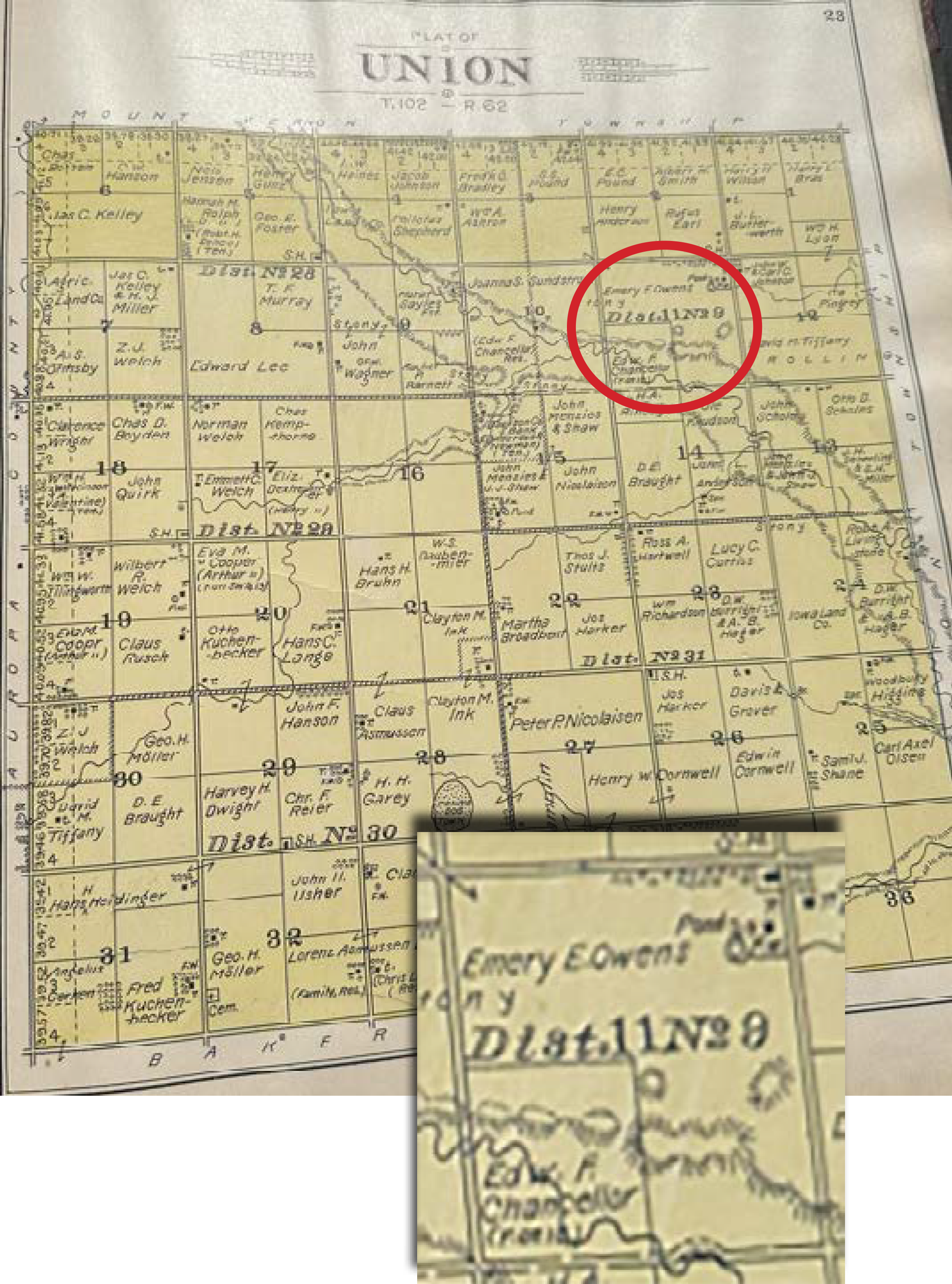
More on my trip to South Dakota to continue my work on David Owens life. Union Township is outside of Mount Vernon, SD. That is the town where my 3rd GG, David Owens, and his wife Eliza Barker Owens settled at the end of their lives. David filed for a land patent in 1884, which was patented in 1889. It was the NW1/4 of Section 11, Union Township. In 1897, Emery Owens applied was granted the NE1/4 of Section 11. Sometime during this period, Emery acquired the SW1/4 of Section 11, making a total of 480 acres. Now, consider that South Dakota is not all Badlands and high desert. The northeastern side of the state is fertile with arable land.  That's a chunk of usable land. David appears to have left his portion to Emery, because by the time the map was published in 1901, Emery had this land, but had to wait to patent the NE1/4 (in 1902).

1902 Union Township, Davison County, SD Plat Map

Here is a photo of the homestead...there's a question whether this was the Owens homestead or another building was there before. According to the owner, the basement is the original basement. This location is at 257th St and 398th Ave in Davison County. I put two not perfectly matching photos below of the homestead.  


Miracle of miracles, I also availed myself of the US BLM database of land grants and was able to find both of the Owens land grants paperwork. I have linked directly to the page with the patents.

David's 1889 Land Patent

Emery's Land Grant. Land previously owned by Wm Brearly

Finally, here are the grave stones of both David Owens and his wife, Eliza Barker Owens.


Friday, December 27, 2024

SMULL: Samuel Gramley's Diaires...High Cost of War

While on my trip to Brush Valley in 2024, I had a few moments to look through the diaries of Samuel Gramley. I have written about him here. Samuel Gramley married Sarah Jane Smull (daughter of Henry Smull, in 1849. They lived in Centre County, Pennsylvania. This is the second post of entries.

March 3, 1865. Many of our neighbors were drafted - 27 of whom must either go or furnish substitutes. There are some drafted for whom I feel sad. Some of my near friends. Harrison Smull, Henry Smull, S. G. Mengle and others for whom I feel sad. All the Shoemakers are drafted.

(Not sure about either Harrison or Henry, but Harrison has no record of service, so he must have found a substitute. Henry Jr. served in the 175th Infantry in 1862 - so did he get drafted after that service?  If you would like to know about Smull service for the Stephenson County, Illinois group, go here.)

March 4, 1865. This was nationally a great and memorable day, as Abraham Lincoln took his seat the second time as President of the United States; and my humble prayer to Almight God this evening is that God's choicest blessings may be upon him  as the Chief Magistrate of our Nation; and that his being President may yet be a blessing not only to our United States, but also to the world; that the long prayed for day of peace may speedily dawn; and that war and the rumors of war may cease O though God have mercy on us.

(A little over a month later, President Lincoln would be assasinated by John Wilkes Booth.)

March 10, 1865. I and several of my neighbors, moved George Deavler into my Tenant house today with sleds, but almost as much through mud as through snow. I am much pained to be compelled to enter in my Journal the death of my nephew, Charles A. Wolf, of Co. A, 18th PV. He was captured by the Rebels some time ago, with others, and was literally starved in their prison. May Almight God reward them for starving so many of our soldiers.

(Charles was the son of Samuel's sister Catherine and Henry Wolf.)

October 29, 1880. My soul feels much grieved from the fact of my irrepairable loss of my dear wife Sarah Jane. It seems to me at times that it could not be a reality that she is no more to be seen in the family. When I watch my two girls Naomi Jane and Adah E go about the house after the work, and their dear mother's voice is no more heard in giving counsel and advice, it almost breaks my heart. O! When thinking of the kind voice speaking and encouraging, not only the children, but also, me, language entirely fails to express my feelings.

(Sarah Jane died in May of 1880.) 

November 4, 1880. Mrs. Polly Walker (Sarah's sister) and Barbara Hoy were here today, assisting me and my little girls to cook apple butter, and also to kill or butcher a little hog. We were quite busy all day, and I feel very much tired. Last evening, I wrote my fourth letter to my Dear friend, Mrs. C.A.O. in Snyder County, and this morning I took it to the PO and then got a letter, and after I came home and opened it, I was not a little surprised and also full of Joy to find it a kind reply from her to my third letter. I felt thankful to God to know that there is still a friend to be found for me, and one, too, God willing, who will come to my assistance in due time, to help to bear my burden, and I hers. May God bless her and me, and help us successfully carry out our purposes.

(This is just adorable. He has started a postal romance with Catherine Spangler Ocker, who was widowed shortly before Sarah Jane died.)

December 30, 1882. Last Monday my dear wife Kate and I were at Millheim with my brother Reuben and his wife at a Lutheran Dinner given for the benefit of their New Lutheran Church which they are building. On Thursday I was out at Henry Wolf's to be present with Road Viewers and now have a severe cold from which I am suffering--severe hoarse.

(There were many sweet entries about his dear wife, Kate. However, she had seven children from her first marriage and visited them frequently.)

My last two entries just remind me of any man or woman in a blended family with teens!

January 6, 1883. My dear wife Kate all at once took a notion to take the train to see her daughter Mary A. a visit at Mifflinburg, and so she did today and will spend this evening and God willing I will meet her next Wednesday evening at Mifflinburg and accompany her back Thursday. I will leave home Tuesday morning for Middleburg, Snyder Co. and come to Mifflinburg as said.

January 17, 1883. We have excellent sleighing, and snowing now most of Saturday a week ago my wife Kate left home for Mifflinburg. On Tuesday following I went to Middlebur in search of the residence of Michael Hetzel, who has become a Township charge, and found that he has his last residence in Washington Township by having paid co. tax twice in succession--1875 and 1876. After having made said search I came to my friend Christian Spangler the same day at Centerville at whose place I staid over night, and the following morning I came to Mifflinburg, where I spend that day with my wife at her daughter's place, and on Thursday we came home about noon. On last Friday, Jan 12, Clement H. and Naomi J. (his children) left home on a visit in Clinton County to their uncle, T. J. Smull at Mackeyville, and also their Royer friends, with the understanding to come back on Monday. This command they both violated, and Clement H. alone came home yesterday. By the influence of the Royer friends Naomi J. staid, which was a violent temptation and disappointment to me, and the disobedience in her I am compelled to reproof severely. I have all the respects necessary for my friends, but they must however in this case be taught that I am the head in my family. I have immediately send her a Postal to be home by Friday or Saturday, if not that I would fetch her on Monday to her sorrow. This disobedience I do not blame as the heart only by the head pursuaded.


Thursday, December 26, 2024

SMULL: Samuel Gramley's Diaries

While on my trip to Brush Valley in 2024, I had a few moments to look through the diaries of Samuel Gramley. I have written about him here. Samuel Gramley married Sarah Jane Smull (daughter of Henry Smull) in 1849. They lived in Centre County, Pennsylvania. I want to share a few entries:

December 24, 1856. Christmas evening. Weather severely cold for about 8 or 10 days already and no abatement yet. The cold has been so severe that no drop of water is now running in our town--all must be hauled from H. Royer's. And, Bear's or John Gramlys. Today Rev. Alleman had communion here and his discourse was based on Psalm 37:37. This too was his last sermon that he may do for us this side of the grave, as he has received a call some time ago from Hanover York County, Pennsylvania, wor which place he will leave this place next Monday. May the Lord's blessing attend him and his family withersoever he goes is my ardent prayer to God. The Lord has severely afflicted us in calling our most worthy Pastor Rev. Alleman to another field of labor. May the Lord soon send us another true, and really pious servant of his, is my wish and prayer to our God, who is willing, as well as ble, to here and answer the prayers of his children. Amen.

(Many entries were prayers or references to God.)

January 31, 1857. It is a long time since I wrote in my journal last and this was I think partly because during this time I met with so many trials and temptations from Satan, my own wicked heart, and from neighbors who are my deadliest enemies, round my back, but to my face seem yet as friends, and facts show are seeking my ruin, in any way they and the Devil think to succeed that I often know why, what to do, nor where I was standing. May God help me!

(There were a few entries that gave me the impression that he had fits of despair that may not have been warranted in the general scheme of things. I wonder who was backstabbing him!)

April 18, 1860. This has been a very fine day and the farmers in every direction were busy ploughing--sowing oats, etc. They are far back with their work on account of too much rain to do anything. Hardly any gardening has as yet been done before today for the same reason. I and Cephas Luther (his son) are alone at home tonight, as Sara Jane and Titus Melancthon have remained in town at Harrison Smull's. Nancy, his wife, is not expected to live long any more. She is very low. She has dreadfully to suffer--n one can hardly stand to see her suffer so. May the Lord have mercy on her, and grant that, should he see proper to remove her from this world, she may be prepared to leave this world in peace, has long been my prayer. Our friends William Walker's youngest child also is very low--hardly any expectations can be entertained of her reocvery. Last night I was there, and Sara Jane till half past one o'clock. Their daughter Jest Ann is in a most pitiable condition, on account of her spells of fits, which she gets so very frequently. I have in my heart already felt for her, as she used to be on of my most obedient scholars--would learn well--and be active at everything.

(William Walker was married to Samuel's wife Sarah's sister, Mary Magdalena "Pollie." Their daughter Jest Ann was born in 1845 and survived until 1890, but was classified as insane - it sounds like she was epileptic, which was a sure way to be classified as insane back in that era.)

April 21, 1860. I have today been digging some in the garden. I owe also a great debt of gratitude to God for his tender care toward me and my family. We are all enjoying good health and strength of body and mind. Sarah Jane has gone to town this evening to spend the night with our friends the Harrison Smulls; as she is yet very low--may not be able to live long anymore. Yet for all we know, she can by the help of God, again recover, as nothing is impossible with God; but to human appearance she may very properly be said to stand; as it were, with one foot in the grave. But she, as well as we, in the hands of him who is able to speak a word and it must come to pass. When he says, "come for thou son of man" we are; and when he says "die," we are no more--as a vapor before the sun, or that the grass is cut down. 

(Nancy McGee Smull, wife of Harrison Smull, died on 05 May 1860 at the age of 29. Harrison remarried to Matilda Hackman, "spinster" sister of Rev. H. E. Hackman, of St Clair, Pa. Matilda cared for her nephew Horace Hackman, son of Rev H. E. Hackman who had lost his wife and remarried and had several very small children in 1870. Unfortunately, Harrison himself would die in Sept 1871.)

January 5, 1861. Since my last entry into my journal we had fine winter weather--cold--excellent sleighing, and about 3 inches of snow. Had large attendance in school. One day more will finish my 2nd mo. I and family had taken a sleigh ride this afternoon to our friend's Henry Smull's. Found them all well. On my home road I received a letter from my friend T. J. Smull, who is teaching in Clinton Co, Pa.

(T. J. Smull is Thomas Jefferson Smull, brother of Sarah Smull Gramley. He would stay in Clinton County, Mackeyville, in particular, where he would spend 50 years as the postmaster there. When he retired, his son Roy took over.)

I'll publish a few more on the next blog.

Wednesday, December 25, 2024

SMULL: Jasper Gurney Smull One of My Favorite Stories

Jasper Gurney Smull, grandson of Henry Smull by his son Henry Kreamer "Harry" Smull, was born in 1901. He grew up and lived most, if not all, of his life in Rebersburg, Pennsylvania. He never married and it appears that he was a mama's boy.  For some time, he worked as a farm laborer in the area. To this day, the story of his time on the Walker farm told a story worthy of a made for TV movie. It remains one of the best stories I've run across, and there have been more than a few, in my family tree, which seems to have more than its fair share of nuts. Here is the story and here is a photo of Gurney, who lived until 1987.


Tuesday, December 24, 2024

SMULL: Henry Smull of Brush Valley

I'm just now getting around to sorting through photos from my big trip to Pennsylvania, to hunt the trail of the Brothers Smull. My first post on my trip is here. I had such a great time with Evonne Henninger who runs the Facebook page Penns Valley Past and Present. Four Smull brothers arrived in Brush Valley to build the Lutheran church in Rebersburg: Jacob, Peter, Henry, and Jesse. Once building was complete, Jesse returned to the family while the three, Jacob, Peter and Henry, remained to build lives in the beautiful newly settled countryside on the other side of the Ridge and Valley Provice of the Appalachian Mountains, sitting between Nittany Mountain to the north and Brush Mountain/Shriner Mountain to the south. Peter was my third great grandfather. Jacob died relatively young but his home still stands on the main street in Rebersburg. Henry and his large family from his two wives, became part of the fabric of the area.

Henry's first wife was Elizabeth Royer, daughter of Johannes Christopher Royer and Magdalene Gross. The couple had seven children. Elizabeth died in 1834 at the age of 37, two weeks after she gave birth to their last child, Thomas Jefferson Smull. Henry then married the daughter of one of the prominent farmers Daniel Kreamer and Anna Kern) in the region, widow Catherine Kreamer Hosterman. They had an additional five children to add to the four children she had during her marriage to George Hosterman. George had died the same year Elizabeth Royer Smull died.  

I had not seen a photo of any of the Brothers Smull until I made my trip to Brush Valley. This is a photo of Henry, born in the 18th century, and his second wife, Catherine. This alone made the trip worthwhile.

Henry Smull and Catherine Kreamer Hosterman Smull c. 1860


Thursday, December 19, 2024

David Owens: The Trip to Mount Vernon...South Dakota

I would direct you to the various stories about David Owens, my third great grandfather. His story wormed its way into my heart and he has been of special interest in my genealogical work. The summer of 2023, I had the pleasure of going to the place he went after he left Iowa. The place where he raised his second family - Mount Vernon, South Dakota. 

Our trip was for the pleasure of the entire family - mostly. Little did my familial traveling companions know, but I had designs on our itinerary that would take us to genealogical wonders (for me, not them) along the way. 

Downtown Mount Vernon 25 years after the Owens arrived

As just a brief summary to those who do not want to read all of my stories, David Owens married my 3rd great grandmother, Sarah Holler. They pioneered through Indiana and Illinois, until arriving in Poyner Township, Black Hawk County, Iowa, where they were part of a group of the earliest settlers. They were baptists. Sarah died shortly after having her son Joseph in 1864. Joseph also died. David almost immediately married Elizabeth Brown, who died in 1866. Finally, he married Eliza Barker in 1867. They stayed in Poyner Township until 1884, when they made the big move to South Dakota where they hoped to homestead. They ended up homesteading two different adjoining properties outside of Mount Vernon, South Dakota.

We had left Mitchell, the Davison county seat, early one morning as I had an appointment with the sexton at the cemetery where David and Eliza were buried. No emails involved - only the phone.  Dale Kroupa, who had lived his entire life in Mount Vernon and knew who lived at every single property in the County, met us at the cemetery. By that time, I had already found the stone in question. We chatted a bit and I told him of my interest in the Owens family. He grabbed his phone, made a call, and said, "Follow me."

Milwaukee, Chicago, St Paul Station

Off we went to the nearby historical museum (housed in what was formerly a church). Dale had called the woman who masterminded the museum, Roberta Olsen, at home. She told him to give her a minute, but she'd be right down to open up the museum.  Now, that's service! She knew every person to a one who settled in the area and how they connected to each other. I poured over tons of resources, books, and plat maps. Dale had tracked the properties down and so we were off again to see the property.  On that day, I got to see the place where they had farmed over 100 years ago. The place did not look much different from it had then. I felt a real connection to David, which just further insinuated him into my heart.

Really, all that racing around was great, but man, I've got to tell you, the kindness of strangers. Am I right? Mrs. Olsen and Mr. Kroupa so clearly loved and were proud of their place in the world and so very willing to share it with others. It moved me very much.  

I delayed telling this story so now I have to dig through my phone for the photos. So, I shall return - with pictures and some other stuff.

Mount Vernons Historical Museum


Saturday, December 7, 2024

Munson Tales: New England Slave Owners

Revelations out of Yale relatively recently brought the public’s attention to the fact that slaves contributed to the building of several early Yale buildings (1747-1752). Called out specifically was the slave of Captain Theophilus Munson, who went by “Dick.” He provided significant labor in building, courtesy of the Captain. The last slave in New Haven was sold on the New Haven Green on March 8, 1825. This despite many other New England states having abolished slavery, some states even before they became states. There was a policy of gradual release of slaves, so the last New Haven slaves were not freed until 1848, just 13 years before the Civil War. 

Connecticut Hall (Yale), built with slave labor

In fact, abolition in most northern states had gradual release rules or the inhabitants just didn’t follow the laws of the land at all. New Jersey, a bastion of Munson progeny, never abolished slavery until the end of the Civil War. Joseph Tuttle (b. 1692), grandson of Thomas Munson’s daughter Hannah, was also a slave owner with eight slaves. Deacon Captain Stephen Munson (b. abt. 1733), who was joined to the 1st Church at Hanover, New Jersey, was named “ruling elder” in 1765 and later deacon. 1st Church published a series of Rules for the Regulation of Families in 1782, of which Stephen was the second signer. One of those rules was: “13. As we suppose all human creatures have a natural right to freedom, so when they have done nothing that forfeits their liberty, and when they do not voluntarily submit to bondage, we cannot but look upon their being held in slavery, as an unnatural evil and one of the greatest injuries to mankind. Therefore we will not use this slavery ourselves, and will prudently endeavor to prevent it in others.” This despite owning a slave named “Caesar.” I guess perhaps “Rule 13” was just a guideline for Stephen.

Thursday, December 5, 2024

Munson Tales: Puritans Turned Polygamists

 Mary Elizabeth Potter (Clan Elizabeth) and Burr Frost married as teens in 1835 in Connecticut. Just seven years later, the couple was baptized in the growing church of the Latter Day Saints, led by Joseph Smith. It had been just six years since the Book of Mormon was written. 

The Frost’s moved west first to Nauvoo, Illinois. Joseph Smith and his followers had originally gone to Missouri, but were ejected by the State of Missouri. In 1844, Smith and his brother were later to be tried for treason in Missouri, so turned themselves in only to be killed by a mob at the jail. There was a power vaccuum, but it appeared that Brigham Young would be taking the lead. 

He organized the first Mormon Vanguard Company. In 1847, 14 groups of 9-14 people were assigned to a leader, an ox, and a wagon. They walked or road over 1,000 miles to the Salt Lake valley in what is now Utah. Burr was included in this first set of settlers in Group Seven, led by James Case. Amazingly, the group arrived safely in July of 1847. It was some time before Burr brought his wife and kids out. 

Though the Mormons were split as to whether polygamy should be allowed, Burr dipped his toe into the multiple-marriage pool by marrying Eliza Morris in 1852, the first year polygamy was out in the open. She was also still married to her first husband, Isaac Nash, with whom she had four children. She and Burr had no children together. However, that changed when Burr married 22-year-old Caroline Triplett in 1864. They had at least eight children together. Burr was a reliable and hard-working member of the LDS church. 

He was an effective proselytizer who was called upon to do mission work as far away as Hawaii and Australia. In March of 1878, Burr died. At the time of his death he was one of the Presidents of the Seventy, a significant leadership position. 

All of his wives outlived him. His first wife, Mary Elizabeth, outlived the younger wives, dying in 1904. Polygamy was banned by the church in 1890.

Tuesday, December 3, 2024

Munson Tales: Larry Welch, Chief of Staff of the Air Force

Young Larry
Thomas Munson > Samuel Munson > Solomon Munson > Samuel Munson > Ruth Munson > Mary Van Cleef > Ruth Ryker > Polley Hillis > John S Welch > Arthur Welch > Oliver Welch > Larry D Welch

Larry Deane Welch was born in a little town called Morningstar in Oklahoma smack in the middle of the Great Depression in 1934. Three kids had come before him and one would follow. His parents, Oliver and Nina (Stewart) Welch spent most of their lives in Kansas but during the Depression moved wherever there was work both north and south of the panhandle. Larry ended up attending a number of schools, but at least he was getting an education. The two country high schools he attended in no way prepared him for college. But, athletics helped him fit whenever he moved. Between junior and senior year, a recruiter for the local national guard battery came through the high school and Larry signed up. It was an honor to be part of the Guard in town. His skill at calculus allowed him the job of fire control. After graduation, he couldn’t decide on what he would do in college, but thought he’d try a degree in Texas. He transferred his Guard membership to Texas. In the meantime, his draft number was closing in on him. He took a test to enlist and though the Army was offering two years, the Air Force was offering three and Larry hedged his bets and went Air Force. 

Joint Chiefs of Staff under Colin Powell (Larry in blue)

There he would spend the next 38 years, rising to the pinnacle position before he retired. After basic
training at Lackland Air Force Base (AFB), Texas, he was on casual duty, waiting for his advanced training. His main chore was helping training staff get their recruits from one place to the next. One day, he was tasked with taking the recruits to the base theatre to be briefed on the Aviation Cadet Program. On the way out, he filled out an interest slip and dropped it in the box. Next thing he knew, he was selected for officer pilot training. He had the same three year commitment, so it was a win-win. The program was like Officer Candidate School, but wasn’t. After the 13 weeks at Lackland for military training, Larry was sent for his six months of flight training. He completed that near the top and was picked for one of three fighter slots. That’s where Larry really wanted to be. Then, the training command decided that the top eight pilots would stay and train future pilots. Among some of these pilots were Majors and Lt. Colonels. The 2-star general for the base called Larry in one day and that he couldn’t have Lieutenants running around telling senior officers their business. And, he pinned on Larry’s Captain bars. This promotion was called a “below-thezone” promotion, which meant it was ahead of schedule. He was thrilled and went home and walked around the house not saying a word about the giant Captain bars sitting on his shoulders. His wife carried on her conversation about going downtown, which was to be their destination, totally unaware, until Larry became frustrated and said he couldn’t go until she noticed something. She finally noticed! 

As any career military member knows, the spouse is what keeps it all together. He married the former Eunice Ellis about a year after he finished flight school in 1956. The were married for 66 years prior to her death in 2022. Larry was then operations officer of the 366th Tactical Fighter Wing He would be promoted to Major below-thezone as well. There was one slot and four candidates. He was told that he was selected because he went to night classes working towards his undergrad degree. He completed it with 170 credits. Then he spent a tour flying F4C Phantoms in Vietnam. He was back to school upon his return, going to Air War College to get his master’s. Like all career officers, he then spent some time in a headquarters environment. He ascribes much of his success to date with luck, but it was not luck that got one of his analysis papers in front of a bevy of generals and altered military policy. 

Larry is known for only
flying left-seat
His skill analyzing a problem and writing it up to have the greatest impact was now revealed. By 1974, he was a Colonel and Vice Commander of the 35th Tactical Fighter Wing at George AFB. From there, movement was swift. He went on to other analysis positions at the Pentagon. He built battle plans for Iraq and analyzed optimal weapons planning. He received a first and then a second and then a third star. He served as Tactical Air Command as Director of Operations and got his fourth star serving as Commander of Strategic Air Command. In 1986 he was promoted to Chief of Staff of the Air Force. This had a required four-year term. The end of that term would come in 1990, the end of the Cold War. 

The Soviet-Bloc countries got their independence and the Soviet Union collapsed. His charge was challenging. He had to implement the Goldwater-Nichols Department of Defense (DoD) Reorganization Act, which basically upended the way the DoD did business. He and the Chiefs managed to get the DoD through the process successfully. 

Where do you go after you’ve reached the top? You retire. Not Welch though. After leaving the service, he chaired the advisory committee to the Homeland Security Agency’s Science and Technology Division. He then some time on the Rumsfeld Commission, which reported to Congress on the ballistic missile threat. In 2009, he retired as president of Institute for Defense Analyses. In 2014, he was asked to work on the Independent Review of the Department of Defense Nuclear Enterprise. He is truly retired now and living in Virginia. His three children includes one son who attended the Air Force Academy and was a career officer, retiring as a colonel in 2024. 

Sunday, December 1, 2024

Munson Tales: Capt Charles Butman Munson Family: U.S.S. Merrimac to Munson Island

Captain C B Munson
C.B. Munson (Clan Daniel), born in New Haven, Connecticut in 1852 on terra firma, would spend 47 years of his life on the water working his way to captain. He’d sailed clipper ships in Asian waters and steamships in the coastal waters of the United States. His story is one of adventure, but ultimately, his favorite spot was at home, with his family. Not terribly tall and thin as a rail, it’s hard to think of this man living a life of seafaring daring-do, but he did. 

Along the way, he found the love of his life, Fanny Gilbert Taylor. Fanny was born in Nassau, Bermuda in 1857. Her father brought her family to the United States, and started work as a crewman on a whaler. Once he had a few children, he worked on land as a carpenter. Fanny and Charles married in 1877 in Florida. The couple settled in Miami, Florida, during his oceangoing years and in later life settled in Jacksonville. They had one son, Charles Newton Munson, called Newt by those who knew him. Newt grew up at the shore as his father spent most of his days at sea. The family spent their time between New Haven, Connecticut, and Florida. 

Newt & Ruth Ellison
Captain Munson gained a reputation as an expert seaman who had served as shipping clerk, boatswain, quartermaster, lieutenant, second officer and first officer, until he ultimately became a captain who mastered every port between Shanghai and Virginia. He was also an expert of ports through Mexico and South America. His expertise was well-known, which is why he was urgently called by Admiral C. T. Sampson on the very day the Spanish-American war began in 1898 to pilot the Atlantic Fleet to Cuba. Battles ensued and Munson would be shifted from ship to ship. Finally, on 1 Jun he was ordered aboard the Merrimac to captain with instruction to let the Admiral rest until 2 am on 2 Jun. At 3:30 am, the crew, save a band of seven volunteers, were removed from the Merrimac and left in the charge of Lt Hobson, who had instructions to block the harbor entrance with a sunken Merrimac. The skeleton crew of seven improvised torpedoes which were placed strategically on the Merrimac. Then, the Spanish fleet damaged the Merrimac’s steering disallowing it to be put firmly in its blocking space at the harbor entrance. Then, only three of the ten torpedoes exploded, but a Spanish mine put a hole into the Merrimac and finally, the continued gunfired and torpedoes sunk the Merrimac in the wrong poistion. The ship was lost for naught, as the harbor was not blocked. Though the ship was lost, the Spanish were defeated in Cuba a month later. 

Captain Munson had many adventures over the course of his career. In old age, he retired to
Jacksonville, where he died in 1933. In 1923, Newt purchased four small islands in the Keys of Florida - Little Munson Island, Big Munson Island, Cook’s Island, and Carrier Island. He barged a building down from Jacksonville to start his winter get-away on Little Munson. He sold one island was sold to Capt. Percy Cook. He gave Big Munson Island to his secretary, Ruth Ellison. It’s not known who Carrier Island was sold to. 

On Newt’s death, just a year after the death of his father, Ada did not go back to the island. She never cared for it. When she died, Little Munson went to Ruth Ellison as well. Ruth sold off Little Munson Island to a Chicago manufacturer in 1936 and then to another owner during the Truman administration. Its greatest claim to fame was being the site for locations shooting for the movie, “PT-109,” which was based on former president John F. Kennedy’s WWII experiences in the Pacific. The island would go through many owners, including drug kingpins and Homer Formby (of refinishing fame) until being sold to a resort club. It is now known as Little Palm Island.

Friday, November 29, 2024

Munson Tales: Another Sherman Brother; Hoyt

Hoyt Sherman
Last issue, we talked about the tormented brilliance of General William T. Sherman. His father, Judge Charles Sherman, and his wife, Mary Hoyt, had several boys who would rise to the top of their spot in the world. Hoyt was the youngest son, born in 1827, just two years before Judge Sherman died of typhoid. Along with brothers John and Charles, he worked in a printing office of the Cincinnati Gazette under the tutelage of publisher Charles Hammond in Cincinnati and studied some law in Mansfield, Ohio, until his majority. 

 In 1848, brothers Hoyt, John, and Charles headed west for Fort Des Moines. At this time, Fort Des Moines was still frontier. Settlers met with Sioux raids and harsh conditions. Des Moines, the city, wasn’t founded until 1850. Hoyt Sherman was there as the area blossomed. Brothers James and Lampson would join him. 

Hoyt began his career selling school land grants out of the office of School Commissioner Thomas McMullen. In 1849 he became assistant postmaster to what was then called “Raccoon River.” When the postmaster left, he was named postmaster. The post office had been in an old building on Fort Des Moines, but Hoyt had a new post office built and then a second location. He held that job until 1852. In 1849, he was admitted to the bar and became a top attorney in the area. 

By 1850, he had turned his attention to the buying and selling of real estate. There was a particular piece of property he wanted to build his home on that was going on auction. He had $100. Unfortunately, others wanted that 5-acre plot as well, and bidding kept hedging up, with him out of money. Then he decided to use his day’s wages, all of $5, to make the winning bid of $105. That plot would eventually hold the Hoyt Place, a large home that would later serve many purposes for the citizens of Des Moines. 

Things kept moving along for Hoyt in Des Moines. In 1852 he was named Clerk of Courts and in 1853 he built the Sherman Block which included a bank and amusement hall as well as executive offices. In 1854, he decided to build a safer, bigger facility to process money from the huge number of land sales. 

He opened his first bank, Hoyt Sherman & Co. Its careful management and the integrity of the firm allowed its immediate success. Feeling pretty good, Sherman went east to Ohio and married Miss Sarah Moultin on Christmas Day of 1855 in Mansfield. He whisked her home and they lived together in Des Moines. In 1856, Sherman was responsible for building the new statehouse on Grimmell Hill after a skirmish of words between those near the “Fort” and those on the east side of Des Moines. That edifice still stands today on Grimmell Hill. 

The original Hoyt Sherman Place

In 1858, the State of Iowa had its new consitution which allowed for the formation of the State Bank of Iowa. Sherman was named the first cashier of the Des Moines branch and he merged his Sherman & Co. bank into the new bank. While his brother William was deeply involved with the Civil War (1861-1865), Hoyt did his part, too. He had been granted the rank of Major and named paymaster of the army, dispensing millions of dollars in funds over the course of the war. And, of course, the post-war audit found not one penny missing. 

In January 1867, the Equitable Life Insurance Co. was becoming quite the firm out West. Sherman was named its actuary. Over the next several years, he moved through the ranks and eventually became president. He made his mark outside of business as well. He was president of the Old Settlers Association and helped start the Des Moines Water Company. In 1866 he served a year as an Iowa state legislator. That lead him to the Pioneer Law Makers of Iowa, where he served as president in 1898 for a term. Things didn’t always go his way, though. 

In 1871, a fire broke out on the west side, wiping out several blocks. One of the buildings completely lost was the Hoyt Sherman place at 6th and Locust. He would go on to build a brick home at the land purchased for $105 at 15th and Woodland In 1887, Hoyt lost his wife, who was mother to his five children. Sarah Moultin had been ill for over a year, but expected to recover. She took a turn for the worse in late February and died in early March. He never remarried. 

 Hoyt’s brothers who had also made Iowa home, John and Lampson, did well too. John became a U.S. Senator and Lampson was founder of Des Moines’ second newspaper, the Des Moines Gazette, and served as Des Moines’ third mayor and as City Treasurer. 

All of his ten siblings died before Hoyt’s death in 1904. Hoyt and Sarah’s five children included: Frank (1856-1902), an attorney who died at age 45 of a stroke. He got his law degree from Columbia University. He practiced privately and served three years as county attorney. Additonally, he organized the first street railway company in Des Moines. He was married with a daughter. Adeline (1859-1917) married ink baron Frank Wiborg and lived her married life in the Hamptons and NYC. She died in NYC in 1917 and had three daughters. Charles (1861-1911) married Bertha Bartlett, daughter of General Joseph Barlett of Baltimore. Charles practiced law in Chicago and New York. He died of a stroke. Arthur (1869-1945) worked in insurance and real estate and retired with his wife to Beverly Hills, California. He was married and had five children. Helen (1873-1961) married W.O. Griffith and lived primarily in Philadelphia. She was a best-selling children and youth author. She had two boys and two girls. 

Hoyt Sherman Place spent time as the Women’s Club and is popular today as a music and arts center and theatre.

Hoyt Sherman Place in Des Moines, Iowa