Wednesday, February 10, 2016

Sideroads: The Remarkable Ripley's William Young Ripley, Part 1

William Young Ripley was the third child of Nathaniel and Sibbel Huntington Ripley. He was born 13 Dec 1797 in Middlebury, Addison, Vermont.

He never spent a day in school, but he and his sisters and brothers were all educated at home. At 12, he was hired out to a farmer, working at a rate of about 19 cents a day for a month. By 13, he was found buying and selling horses on his own and driving long distances, delivering goods. Thirteen was also his age when his mother died. His father had by this time moved to his own farm in Weybridge.

According to With Pen and Sword: Lives and Times of the Remarkable Rutland Ripley's, by Robert G. Steele, Ripley stated, "I fully expected to be a farmer, and live and die in Weybridge. But on the morning of September 11, 1814, I went up to Middlebury, my worldly possessions being some clothes tied up in a handkerchief. There I hired as clerk for Mr Hager's store for $30 a year, and my board and washing."

His wages grew to the princely sum of $150 and he spent four years with Mr Hager. Now 21, he took his employer's "recommendation"  and character references signed by no less than the governor of Vermont and 34 other noted citizens, and joined his brother Samuel in Charleston, South Carolina.

According to Julia's story in With Pen and Sword, his brother did not greet him warmly, thus leaving William to fend for himself. After a couple of unsuitable job, he went to work for Mr. Bryan at his dry goods store for an annual salary of $450 plus lodging and a good discount.  Within a year, his wages had been raised to $750 and he was able to pay his brother Samuel back the small amount he owed him. While living with the Bryan's he met his future wife, Zulma Caroline Thomas.

Zulma was the daughter of Londoner Jean Jacques Thomas and Susanne De Lacy and was born on 29 Mar 1801. She was orphaned at a young age and was raised by Captain William Hall.

In 1822, William went into business for himself and married his bride on 05 Dec 1822. They boarded
Poet Julia Ripley Dorr
with the Bryan's for several months before purchasing a home for $1,000 - William wanted to owe no man according to his report.  Finally came the birth of their only child, Julia Caroline, on 13 Feb 1825. Julia would grow up to be the famous poet, Julia Ripley Dorr.  William purchased his only slave, Nancy, who was to be a nanny to Julia, but "She did not behave well, and I would not send her to be whipped, as was the custom. She took advantage of this leniency; and so I sold he to get rid of her, for just five dollars more than I paid for her." When they moved to their home on King Street, they had three servants: cook, chamber maid, and nurse. All three were cumulatively paid the princely sum of $22 per month.

Zulma's health was failing so the Ripley's had her bed loaded aboard a steamer in the Charleston Harbor. They made it to New York and then finally reached Nathaniel Ripley's house in Weybridge on 29 Jul 1826. After a brief rally, she died on 02 Aug 1826. According to Julia Ripley Door, "Prominent among the early settlers of Middlebury, were the Youngs and the Warrens, close friends and intimate neighbors of the Ripleys." Both families were in attendance for the Ripleys in those dark days.

Once Zulma was gone, William set about closing up his affairs in Charleston. Julia was left in the care of Mrs Hastings Warren. Julia remembers those two years fondly. By the time her father had established his firm of Ripley, Waldo & Ripley, commission merchants in New York, and had called for his daughter, she had forgotten him. She did adjust and off they went to the home of Mrs Westcott who ran a boarding school for a small group of girls. Julia spent two years there. Then, it was back to Vermont and Grandfather Nathaniel's house. It was there that William announced to her he was remarrying. She was six. The wedding to Jane Betsey Warren, was held  on 10 Feb 1831.

Her first sibling would arrive two years later - William Young Warren Ripley on 31 Dec 1832. Julia again found herself shipped out soon after his arrival to a boarding school in Plattsburgh, run by Mrs Harriet Adams, a sister of "Grandmother Warren." It sounded, from her description, to be a less than happy time spent there.

In 1834, she returned to find a sister, Mary, born 17 Jun 1834. She spent a lot of time from that point forward at the Warren's in Middlebury, attending school in bits and pieces here and there.

William, in the meantime, had wearied of the farm life, having not reached 40. He invested in a glass factory in Lake Dunmore. He also sold the farm and moved to Rutland. Here he would embark on his second and most successful career.

Told in Part 2.


Tuesday, February 9, 2016

A Big Sideroad: William Harvey Baker

William Harvey Baker has no connection to me at all. He is the brother of a young woman who
Look at that baby face
married a Ripley descendant so far removed from my family as to be silly of me to be researching. But, in the course of this sideroad - which I feel compelled at times to go down because of sheer curiosity, I discovered a tragic tale.

Raymond Hugh "Punky" Shores (the Ripley relation) was 18 years old when he died. He'd just gotten married to William's sister (not named because she is presumed to be still living) who was also 18. He went to work for a logging company and was killed in an accident very soon after. According to the report, he got wedged between a log loader and a lumber truck and was crushed. He died en route to the hospital.

His young widow had a really bad week. Only the day before, her mother, Theresa (Miller) Baker, 38, was arrested for the murder of her former husband, William Garland Baker, age 40. She sat in Ada County jail in Idaho for some little time before her story started to unravel.

Mrs Baker stated that while having dinner with the family, Mr Baker became threatening. Mrs Baker went to the bedroom to get a .25 automatic pistol and returned and started firing.

After days of intensive questioning, an entirely different story came to light.

Idaho State Journal, Pocatello, ID 20 Dec 1955
Mrs Baker spent 10 days in the county jail when at last young William Harvey, under questioning, finally confessed to the crime. After his father threatened to kill the entire family, Mrs Baker sent the youngest son, Crocket, out to get wood and she left the room. She heard two shots, returned to the room, and fainted. When she regained consciousness, she took the gun, a .25 caliber Italian automatic pistol, from her son and told him she would take the blame.

He was charged with homicide under the Youth Rehabilitative Act, was sent to trial on 05 Jun 1956. He was found guilty of manslaughter and sentenced to no more than 10 years in the Idaho Penitentiary. The records I located indicated he may have been released after serving four years, in 1960. He went on to live a full life, dying in 2008 in New Mexico. His mother predeceased him in 2001.

What a baby faced young man. We can only speculate what the conditions were that caused both the divorce and the death. But, abusive husbands and ex-husbands were no less prevalent then than they are now.


Sunday, February 7, 2016

Sideroads: The Remarkable Ripley's Judge Colonel David C Ripley

Several of Joshua Ripley's children were as adventurous as he himself had been. And many left Appalachia for Iowa and Illinois. But for today, we will focus on his third child, David C. Ripley, the forefather of many of the northeast Iowa Ripley's.

David was born in Warren County, New York on 20 Feb 1798. He then moved to Gallia County, Ohio, deep in Appalachia, where his father had gone to preach the Baptist gospel. He married Easter Griswold on 13 Oct 1819 in Lawrence County.

He served his first term as Sheriff of Gallia County from 1834-1838. He then served a term as a state legislator for the term beginning December 1838. After his service in the legislature, he served as Sheriff again from 1845-1853.

After a visit to Iowa in 1853, he and his wife had seven children by the time he decided to join his oldest son, Sanford, in Riverton Township, in what became Floyd County, Iowa in 1854. Sanford had arrived in Nashua, Chickasaw County, the year previously. David's brother Joseph's entourage, of which Sanford was part, had arrived. "The following year he moved in 94 N 16 W, where he built the log house in the grove in which all early settlers were welcome to stay until they had their cabin or shanty finished." Joseph's family eventually moved on to Fremont County, Iowa. David's father Joshua (see previous post) and sister Roxie and husband John Dovenor, sister Cynthia and husband Stephen Johnson, and sister Phebe and husband George Carter all came to Cedar County some time prior to 1850. Phebe is reported to have died there in 1849. George returned eventually to Gallia County.

The Ripley's were one of the founding families in the area, along with several other Gallia County families including the Parishes, Warburtons, Wilcoxes, Clarks, Dyases, Gibsons and Perrys. He was elected County Judge which position he held during the old county seat fight.

Ripley Bridge, Ripley Crossing, Floyd County
This was rugged, untamed territory and after multiple skirmishes with Indians, including a solo foray by David into Minnesota after the raiding Indians, the David Ripley's pulled up stakes and relocated to Boulder in the Colorado Territory in 1861. There he again felt the call to serve and rode with the Territorial Rangers during the Indian Wars. He then served in the Colorado Territory Legislature, Third Session in 1863, where he served as the Chairman of the Education Committee.

In 1866 he came east, stopping in Missouri, where he lived one year. He then came back to Iowa, settling in Fremont County and Decatur County but by 1870 had returned to Riverton Township where he lived with his son Sanford. He suffered from prostate cancer for five long, painful years before dying in 1881. His wife Easter lived until 1893.
Judge Colonel David C Ripley & wife Easter Griswold Ripley
Judge Colonel David C. Ripley's funeral was attended by many. His son Sanford also made a mark in the Floyd County area. This sketch was published:
"Sanford Ripley was born in Gallia County, Ohio, July 27, 1829.  He left there in March, 1953 and came, via the Ohio and Mississippi rivers, to Muscatine, Iowa; from there with a two-horse team, in company with others, to Red Oak Grove, Cedar County, Iowa; from there to where Nashua is now, June 4, 1853.  His father built the first house inside the town of Nashua.  George H Clark built one a little outside in 1851 or 1852.  In the fall of 1854, Mr Ripley moved to the place where he still lives, section 34, range 15, Riverton Township.  Snow being knee-deep and no house there, the family camped under the wagon till he could build a cabin.  He has 250 acres of well-improved land.  He married in 1846 to Susan Norton, nee Bumgartner, who was born in Gallia County, Ohio, in January 1820.  They have three childre, Esther, born Dec 31, 1855; Lovina, Oct 6, 1860; Maria, June 14, 1863.  He ran out with a compass and staked the first road from Nashua, going in a northwesterly direction till he struck section 1, range 94-17, which is now Union Township.  This continued to be the regular traveled road for may years. 
History of Floyd County, Iowa;  Together with Sketches of Its...Vol 2"
The sketch does not include his son William, who died in 1881 and is buried in Riverton Cemetery.
Sanford Ripley Family: Front Sanford & Susan Back: Lovina Ripley Parker, William Ripley, Mariah Ripley Lindaman, Easter Ripley Wert (before 1881)

Riverton Cemetery in Floyd County is chock-full of early settlers, incuding David Ripley, his wife Easter and many of his children. The names in this cemetery are rife through the early history of this area.

We'll head back to Nathaniel Ripley's son, William Young Ripley, of the Remarkable Ripley's of Rutland, Vermont, next.

Sunday, January 24, 2016

Sideroads: The Remarkable Ripley's - Generation 5/6

David was the son of John Jr./III, born 30 Jul 1744 in Kent County, Rhode Island. He married Susan Priscilla Dunbar on 15 Dec 1764 in Hanover, Plymouth, Massachusetts.  They had five boys, three of whom survived infancy.
David left Massachusetts after 1765 and is found in New York before 1768; there his military service starting before ('colony') 1776 is recorded.

Note that after their marriage which is well documented, David and Priscilla moved to Washington County, New York, and occupied lands which had become opened after the end of the Revolutionary War in 1783, and made available as a settlement frontier. This land was formerly occupied by some Loyalist farmers, but mainly by Six Nation Indians who were also largely Loyalists. All of these made their way to Canada, in small family and group treks, under the leadership of Chief Joseph Brant, where they were resettled in a wide swath of hinterland around the Grand River in Ontario, sweeping from Middlesex County in the west, eastward to Fort York, the site of modern Toronto. There is a gap of several years, where records - for both groups - are lacking. This is because they did not yet have organized churches with clergy who made and filed records, and lacked towns with clerks to keep records. Thus records were not kept in an organized way, and cannot now be located readily. The family history shown here has been made of a composite of whatever records could be found, and historical notes and records made from memory, years later. Changes may occur as new records emerge.
http://freepages.genealogy.rootsweb.ancestry.com/~westxan/4759.html
David and Priscilla spent some time in Warren County, then Hoosick, Rensselaer County, and finally settle in Spafford as one of its earliest settlers on land that was referred to as "Ripley Hill." Both he and Priscilla died in Spafford. Their sons James and Jonathan remained in the area and extended the family holdings. Youngest son Joshua becomes part of the next story.
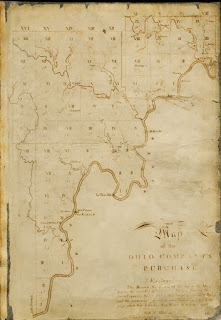

Ohio Association Land Purchase
 (see link at left)
Joshua Ripley, the fourth son of five and third surviving son of David and Priscilla, was born 12 Feb 1772 in Columbia, New York, He married Rhoda Corey in 1793 in Troy, New York. Joshua served with Captain John Griffin's Company in Col Joseph Wilcox's Cavalry Regiment (New York) during the War of 1812. After service, now a Baptist minister he and Rhoda moved to Gallia County, Ohio.

Gallia County, in Southeast Ohio in Appalachia, was first established in 1803 (read more here about how land partitioning and ownership occurred). The Ripley's and John Lee arrived sometime between 1816-1820 (depending on source). They started a branch of the Sandfork Baptist Church and began building their congregation. The first church was built on land donated by the William Smith family in Harrison Township, Gallia County, in section number seven near the junction of Rock Lick Creek, and Big Bullskin creek. This church burnt in 1826 and unfortunately the first record book was destroyed and all records of the first several years of the existence of the church were lost. It is said that the building was built of logs, and that each log was of buckeye timber. The first building was furnished with seats made from split logs and located 11 miles from Gallipolis, in a near due east direction, and it was the first church built on the south side of Gallipolis for more than 30 miles. Some time around 1832, the congregation decided to invite Jacob Ward to be their preacher.

Some of Joshua's children headed West to Iowa in the 1840s. It is believed by some that Rhoda died at Linn Township (not to be confused with Linn County) in 1847.  Census records, of course, didn't call out family members by name prior to 1850. Joshua was in Linn Township in 1850 living with his daughter Roxie Ripley Dovenor's family.  In 1860, at age 87, he was living with the family of son Amos in Patriot. Since we don't know if Rhoda made the trip west, we can assume one of three things: 1) She died in Cedar County but since no death records were kept in those early days, she was buried there and only a stone marked her life in Ripley Cemetery in Gallia County; 2) She died in Cedar County and her body was returned to Gallia County where it was interred in Ripley Cemetery which would have been an arduous journey before rail lines reached the area; or 3) She did not make the trip to Cedar County and the Ripley/Dovenor family's made their trip after her 1847 death and burial in Gallia County. No one seems to know the answer, so the mystery remains unsolved.

This generation would mark the first with ties to Iowa, where roots are still deep.

---
Nathaniel Ripley, son of Joshua, Jr and Elizabeth Lothrop, was born 14 Feb 1768 in Windham, Connecticut. He was four times married. His first wife was Sibel Huntington, the mother of his first seven children. Sibbel was described in With Pen or Sword, The Remarkable Rutland Ripleys by Robert G Steele, as having had white hair at a very young age. She always covered it with a turban to hide it.  Nathaniel did what generations of members of this family had not - he moved.  He settled in Rutland where he purchased land
"Nathaniel was described in the same book as, "He was a tall, spare man, rather severe in aspect, masterful in manner, and very reserved. He had even more than the common New England reticence of that day. What he knew, he knew absolutely. His word was not to be disputed or gainsaid."
"He was a carriage maker and a farmer. I think he was not a successful man financially, because I know that my father, his second son William--supported him for many years, making his last days care-free and happy."

Nathaniel's son William Young Ripley is the next generation we'll focus on, but his other children of Sibbel do bear mentioning, so I do so briefly here:
Samuel Painter Ripley (1792-1857) moved to Charleston, South Carolina and became wealthy. His son Bentham was stationed at Fort Moultrie, Sullivans Island, South Carolina during the Civil War as part of the CSA. The fort fortified Charleston, South Carolina and saw action during the Revolutionary War. It also saw some of the earliest action of the Civil War. Bentham did not marry, dying at age 26.
Julia Ripley (1794-1858) married Jonas Rice and they resided in Bridport, Vermont. Jonas had had three previous wives but still had two daughters with Julia.
Erastus Ripley (1801-1802)
Laura Ripley (1804-1846) was the first wife of Rev Nelson Barbour.
Elizbeth Ripley (1806-1851) married Rev John Stocker and died in Iowa.
George Huntington Ripley (1808-Unknown) During the Texas Revolution, government officials in Washington-on-the-Brazos, decided to establish an official navy. In January 1836, agents purchased four schooners: Invincible, Brutus, Independence, and Liberty. Under the command of Commodore Charles Edward Hawkins they helped win independence by preventing a Mexican blockade of the Texas coast, seizing dozens of Mexican fishing vessels and sending their cargoes on to the Texas volunteer army. By the October of 1837, all of the ships had been lost at sea, sunk by the Mexican Navy, run aground, captured, or sold, and replacements were being procured. It is possible that George died at sea or in battle.

From Pen or Sword, The Remarkable Rutland Ripleys by Robert G Steele. References to Julia Ripley Dorr's earlier book: "George was a gay, debonair young scapegrace, handsome, admired, and fond of leisure and pleasure. Like his brothers, he drifted southward, going to New Orleans. What he did there I never knew. I never saw him but once when he visited the North in 1834, or thereabouts; but I well remember how he looked, and how fine I thought he was. Two years later, whe he was 28, he entered the Texas Navy, and that was the last his family ever knew of him."

Who knew Texas ever had a Navy? I learn something new every day.

I'm going to dedicate an entire post to William Young Ripley, so look for that next.


Sideroads: The Remarkable Ripley's, Generation 3/4

As mentioned, I've been digging into two lines of John Ripley, the son and co-immigrant of his father, William Ripley. To catch up, go here.

Hezekiah was the second son of John II. He and his wife Sarah Garnet lived in Hingham, Massachussetts for their entire lives, They had at least nine children, but for this tale, we're following his third son, John.
John's father died at the age of 43, in June of 1736, and his mother Sarah, remarried to John Pratt, in September of 1737. John was only 16 years old at the time and it's possible that he did not get along with his new stepfather. In any case, young John set out to find his own way in life, probably between 1737 and 1739, and headed for the land of new religous freedom, Rhode Island.  John most probably traveled by ship on this journey, possibly working on the ship to pay his way, as it is doubtful that he had any money at the age of 16.
From the birth of John's first child, we know that he must have arrived in Rhode Island by at least April of 1739, nine months before his first child's birth. He married Meribeth Lee (sources also reference Meribah Messenger as his wife - I would be eternally grateful to have this sorted out by someone) who was born in Rhode Island in 1718. All 10 of John's children were born in Kent County, Rhode Island.
John later moved to New York State, probably between June 1775 when his daughter Jane was married in Warwick, Rhode Island and before 1777 when his son Asa became a militia volunteer in the Revolutionary War, from New Canaan in 1777.  
http://www.ripleygenealogy.com/Page_95.html
---

Joshua II Ripley the fourth child of Joshua and Hannah Bradford Ripley, was born 13 May 1688 in Windham, Connecticut. He married Mary Backus on 03 Dec 1712 in Windham. They made their home in Willimantic where for some brief time (mostly likely thanks to his father's connections), he was a proprietor of the Willimantic Iron Works. The iron works was never very successful, thanks in part to frequent ownership changes, but did employ a number of people over its years of operations. Eventually, it was abandoned and was swept away in a flood. Joshua and Mary had at least 13 children and both died in Windham County.

Joshua Ripley Jr (or III, depending on source),  was the sixth child of  Joshua II and Mary Backus. He was born 30 Oct 1726. He married Elizabeth Lothrop. the daughter of  Benjamin Lothrop and Mercy Baker, born 09 Mar 1730/1 at Barnstable, Massachusetts, on 26 Mar 1748 in Windham, Connecticut. Of this Joshua little is known other than he was both born and died in Windham and had at least 10 children, including his 8th, Nathaniel, who is up next.

Monday, January 11, 2016

Sideroads: The Remarkable Ripley's; Generation 2


As I mentioned in my last post, I am following two of the Ripley lines through the generations. Each line took startlingly different routes through history. John and Joshua, both sons of John I and grandsons of William, the patriarch settler (but not the first) in America, were each reared in Hingham, Plymouth, Massachusetts where William had been granted four acres of land, some of which was owned by the Ripley's for generations afterwards. Their father John owned property in Hingham and was if not well-off, well-placed and respected.
Built in 1692, the Ripley Homestead  is made up of
three sections, each added as the family grew. It sits on .61 
acres in near town center at 347 Main St.

John II (as we'll refer to him here), was the first-born of John I and Elizabeth Hobart, born 20 Feb 1656  in Hingham. He married Miss Jane Whitmarsh, born 08 Apr 1664 in Weymouth, Norfolk, Massachusetts, on 13 Oct 1686 in Hingham. According to records, he resided on Main Street, near Bull's Pond with his family.

"Commencing at his (Lt Smith's) house and thence extending south to the present location of Pleasant Street and cast to that of Spring street and bounded north by Leavitt, and west by Main Street, was a large common or training-field in which, probably not far from where is now the Public Library, was Hingham's third fort, doubtless under the immediate charge of Lieutenant Smith ; and which in connection with his garrison house, provided a fair means of defence to most of the houses on the plain. Around this field were the lots of many of the first settlers, and the homes of their descendants formed at this time a village. Among them on Main Street was that of Matthew Hawke, afterwards the third town clerk. From him is descended Col. Hawkes Fearing, whose house is upon the same spot. Matthew, one of the first settlers, was by occupation a schoolmaster. His granddaughter married John Fearing, Colonel Fearing's paternal ancestor. James Hawke, son of Matthew, also resided at Hingham centre and probably with his father,—he too becoming town clerk in 1700, succeeding Daniel Gushing ; and was himself succeeded in the same office by his son James, also a resident of this part of the town, and with whom the name ceased. He left two daughters, one becoming the mother of John Hancock. Next them was Francis James, and but a short distance further south, about where David Hersey's house now is, was the homestead of the Ripleys, and on or near it were located John Ripley and Jolin junior and his brother Joshua. Their nearest neighbor, John Bull, " Goodman Bull," was the progenitor of many of the present inhabitants of the town. Bull's Pond, a small bit of water opposite Grand Army Hall, takes its name from the old settler, and marks the location of his property."
~  History of the town of Hingham, Massachusetts, by Bouve, Thomas, Bouve, Edward Tracy; Long, John Davis; Bouve, Walter Lincoln; Lincoln, Francis H; Lincoln, George; Hersey, Edmund; Burr, Fearing; Seymour, Charles. 1893.

The second son of John II, Hezekiah, was born on 29 Mar 1693 in Hingham to John II and his wife Elizabeth. Hezekiah married Sarah Garnet (also listed as Gardner and daughter of Stephen and Sarah Warren Garnet), who was born 31 Jul 1691 in Hingham, on 16 Feb 1716 in Hingham. Hezekiah, too, remained in Hingham until his death. Not much is known about Hezekiah, but he managed to have a number of children and live a long life.

Joshua was born 09 Nov 1658 in Hingham, the second of John I's sons. Joshua scored big when he married into the family of America's first settlers at Plymouth Rock and would set the tone for their upward mobility. Hannah Bradford was the daughter of Major William and Alice Richards Bradford and granddaughter of  William G Bradford, Plymouth Colony colonial governor.

Of Hannah: "She was a noble and useful woman, remarkable for her skill in the art of healing, she was the first, and for a long time the only physician in the settlement, and it is said that the first male physician, Dr. Richard Huntington, received much of his medical knowledge from her." She married Joshua Ripley at Plymouth, MA on 28 November, 1682. They made their way from Plymouth first to Norwich, Connecticut in 1688 (where Jeremiah and Hezekiah also traveled) and then to Windham in 1691, where he made his name.

"After a land dispute, a large tract of land was apportioned in the territory of Windham, Mansfield, Chaplin, Hampton, and Scotland in Windham. On May 1, 1686, the legatees assembled to receive their allotments, and "after prayer for direction and lessing" they drew lots, some receiving one, others several shares, according to the decision of Uncas (regarding the land dispute). On May 26, 1688, Richard Bushnell sold lot II, with thousand acre rights for ten pounds, ten shillings to Jeremiah Ripley, of Hingham and Daniel Wetherell sold an allotment to Joshua Ripley. In the autumn of 1688 John Cates built the first house in the new plantation in 1689. In 1691 Joshua and Jeremiah Ripley, John Crane and others built houses in the "Hitherplace." now the west side of old Windham street. 
May 12, 1692, the new settlement was made a new township and named Windham. Eleven names were signed to the petition asking the creation of the new town, and the name of Joshua Ripley headed the list. The first public town meeting was held June 12, 1692. Joshua Ripley was chosen town clerk. It was voted to petition the general court for liberty to portion town charges, and that Joshua Ripley should manage it. In 1693 Jonathan Ginnings and Joshua and Jeremiah Ripley were allowed to set up a saw mill with the privileges of a dam at No Man's Acre Brook. Joshua Ripley was elected in 1698 town clerk, and was also the first justice of the peace appointed in Windham County. He was the first deputy sent by the town of Windham to the general court. This was in May 1699 and he held this office until 1721. 
He was one of the members of Rev. Mr. Whitney's church, formed December 10, 1700. Joshua Ripley, John Backus and three others were a committee to direct the building of the first church. 1702. Mr. Ripley was repeatedly chosen to arrange town boundary lines. In 1704 there was trouble with the Indians and a train band was organized and a watch maintained. Messrs. Whiting, Joshua Ripley and Crane were appointed a committee for the proprietors of town lands with power "to order any meetings, put to vote any matters to be acted upon, and sign the acts." New lands were added to the town and Joshua Ripley was one of those employed to divide them and lay out a highway. 
In 1713 a new meeting house was built and Joshua Ripley with three others again arranged the seating, and two of them, Joshua Ripley and John Fitch, received "the chief seat in front." In 1725 Joshua Ripley was chosen one of the representatives of the brethren to act with the deacons, thus "forming one of the seven pillars," or counsellors, so dear to the early settlers, and the pastor was requested to consult with them "on all emergent occasions. 
The first court of pleas which met in Windham County was held at Windham Green. Joshua Ripley was justice of the quorum for Windham. Joshua Ripley Jr. was a juryman. Joshua Ripley at one time owned the iron works, but these were not remunerative, and were sold in 1 73 1. Joshua Ripley died after fifty years of active public life. It has been written of him "He was a man of sterling sense and sound judgment, widely known and respect," and "often called to public services in different parts of the colony." ~
Genealogical and personal memoirs relating to the families of the state of Massachusetts; by Cutter, William Richard, 1847-1918, ed; Adams, William Frederick, b. 1848, joint ed, Vol IV

Next up, Hezekiah and Joshua II and the next generation.

Sunday, January 10, 2016

Sideroads: The Remarkable Ripley's, Generation 1

William Ripley was born in Ripon, North Yorkshire, England, not far from the Ripley Castle on 14 May 1598. He had three wives in short order while living in England and several children with each wife. While living in England, he supported the family as a "glover."

In 1638, William, his third (of four) wife Susannah, daughters Mary and Sarah and sons John and Abraham, boarded the Diligent in Ipswich and headed to the New World, arriving, according to village records, in Boston on 10 Aug 1638. The ship held 133 souls. The Ripley's set out on foot, going 13 miles, to Hingham (along with many of his fellow travelers) where they stayed. (One theory espoused by a Ripley researcher is their trip did not occur until most likely 1640 or 1641, but I'm for the time being going with the records of the Hingham Town Clerk). The Ripley's settled in Hingham which had been founded in about 1633, not far from where the original Mayflower residents disembarked at Plymouth Rock only a few years previously. Others of his brood also made their way to America, but I'm going to focus on son John. William  was granted land in 1638 on Main St. by the training field in Hingham Centre. His house remained in the Ripley family for 300 years before it was torn down in 1940 and replaced by a fire house. While living in Hingham, he was a weaver. He became a Freeman May 18 1642, married his fourth and final wife, Mrs. Elizabeth (Partridge) Thaxter in 1654, and died soon after in  July 1656.

Hingham Hingham is one of the oldest towns in Massachusetts. There were settlers here as early as 1633. Its first name was Bearcove or Barecove, believed to be most likely Barecove because of its exposure of  nearly all the harbor at low tide. 
"The number of persons who came over in the ship Diligent, of Ipswich, in the year 1638, and settled in Hingham, was one hundred and thirty three. All that came before were forty-two, making in all one hundred and seventy-five. The whole number that came out of Norfolk (chiefly from Hingham, and its vicinity) from 1633 to 1639, and settled in this Hingham, was two hundred and six. This statement, on the authority of the third town clerk of Hingham, must be reconciled with the fact that there was a much larger number of settlers herein 1639 than would appear from his estimate. They undoubtedly came in from other places, and I am inclined to believe that there may be some omissions in Mr. Cushing's list."
"In these first settlements the ministers were the leaders. Their influence was supreme. They gave tone to the time, and color to history ; and the communities which they largely moulded seem, as we look back upon them, to be toned by the ecclesiastical atmosphere which the clergy gave to them. But with all this there was still all the time an immense deal of human nature. The picture of the early time, if it could be reproduced, would present a body of men and women engaged in the ordinary activities of life, cultivating the farms, ploughing the seas, trading with foreign lands and among themselves, engaged in near and remote fisheries, maintaining the school, the train-band, and the church, holding their town-meetings, — a people not without humor, not altogether innocent of a modicum of quarrel and greed and heart-burning, yet warm with the kind and neighborly spirit of a common and interdependent fellowship." 
"Their early records deal with every-day details of farm and lot, of domestic affairs, of straying cattle and swine, of runaway apprentices and scolding wives, of barter with the Indians, of whippings and stocks and fines for all sorts of naughtinesses, of boundaries and suits, of debt and legal process and probate, of elections and petty offices civil and military, and now and then the alarum of war and the inevitable assessment of taxes. They smack very much more of the concerns, and the common concerns, of this world than of concern for the next." ~  History of the town of Hingham, Massachusetts, by Bouve, Thomas, Bouve, Edward Tracy; Long, John Davis; Bouve, Walter Lincoln; Lincoln, Francis H; Lincoln, George; Hersey, Edmund; Burr, Fearing; Seymour, Charles. 1893.
Son John married Elizabeth Hobart, daughter of Rev Peter Hobart & Elizabeth Brook in about 1654 in Hingham. They had seven children: John, Joshua, Josiah, Lt Jeremiah, Peter, Rebecca, and Hezekiah. Rebecca died in infancy and Hezekiah as a young man drowned at age 20 while attempting to ford the Shetucket River.

The next few posts will be following through the generations of John and Joshua. Each took completely different routes - one being the progenitor of some of the most notable families in American and one the father of a line of farmers that eventually landed in Iowa.