Wednesday, July 6, 2022

Clan William: The Southern Contingent: The Stricklands

Trail of Tears

Today's story takes us into the Deep South. Not a lot of Munsons headed down south in the early days of pioneering, but headed west. The first big contingent of Munson descendants were descendants of Olive Maria Munson (1801-1866) and became part of a vast family of Southern Stricklands.

The descendancy goes like this:

Capt Thomas Munson > Samuel Munson > Samuel James Munson > William Munson > William II Munson > William Munson > Olive Maria Munson m. Silas Strickland

From what I can tell, Silas was born somewhere in New York in 1802. According to the Munson Genealogy, he was "of Connecticut." Silas married Olive in Georgia in 1829. It appears that Silas began farming in Georgia at Youngs Valley, Talbot, Georgia before 1830 (Harrall's Valley). In 1834, Strickland purchased 202.5 acres of land in Talbot County by auction for $361. There is also some indication that Strickland participated with the Hamilton's Co. I of the Georgia Militia in the "Cherokee Wars." Then president Andrew Jackson wanted the land east of the Mississippi for settlement and commerce. To that end, a federal law was passed in 1830 which called for the movement and removal of Indians (Indian Removal Act) from lands east of the Mississippi. Despite the Cherokee leaders calling upon Washington for help, by 1838, the US government started forced removal of the native populations, including the Cherokee in Georgia. Thus began the lamented Trail of Tears a tragedy-filled mass movement of indigenous people.

By 1840, the Stricklands were living in Russell, Alabama. According to the 1840 Census, the household was made up of seven members and they had a whopping nine slaves.

That kind of shocked me. For one, slaves!  Two, you have to be pretty darned well off to hold nine slaves.

That year was also the year that Silas was selected to be a delegate for the Democratic Party for the State Meeting during the election year.

Silas wasn't long for this world though, and died in 1841 in Russell County. He left five living children and his wife, Olive Munson Strickland. 

Olive remarried to Carter Jackson in 1845. I have found nothing of note about him except he was 80 years old in 1860 and she 59. She was obviously not listed with him in the 1880 Census, when she lived with family at Warrior Stand, Macon County, Alabama. She died on 02 Nov 1886.

This is merely a launching point to learning more about our Alabama Munson connection. You can read about the death of youngest Strickland son Buren's Civil War death here. Stay tuned for more.

Apppointment of Delegates


Tuesday, July 5, 2022

Clan William: The Brilliant Scientist William Webster Hansen


Today's subject is the brilliant scientist, William Webster Hansen. A member of Clan William he descends in this way:

The Forthcamp Ave Neighborhood

Capt Thomas Munson > Samuel Munson > Samuel James Munson > William Munson > Martha Munson > Reuben Doolittle > Ormer Doolittle > Caroline Doolittle > Lydia Webster > Laura Gillogly > William Webster Hansen m Elisabeth "Betsy" Ross

William Webster Hansen was born to William George Hansen, son of a Danish immigrant, and hardware sales manager and his wife, Laura Gillogly, daughter of Rev James Lee Gillogly and wife Lydia Lucelia Webster on 27 May 1909 in Fresno, California. William had one sibling; a brother, James L Hansen (1917-1993).

Fresno High completed in 1889
William grew up at 735 Forthcamp Ave in the Lower Fulton-Van Ness neighborhood of Fresno. In the early 1900s, the neighborhood was full beautiful homes and cottages which were nearby the new trolley line. William excelled in school and graduated from Fresno High School at the age of 15. Following  high school, he attened Fresno Technical School for a year before winning the Dickey scholarship and moving on to attend Stanford University. He was elected to both Phi Beta Kappa and Sigma XI, the two highest national honor fraterntieis. Nearing graduation, he was then picked up as an instructor in the theory of electro magnetism and electrical measurements for the coming year. He received his PhD from Stanford in 1932 in Physics.After three years as an instructor at Stanford, he was awarded a National Research Council fellowship to MIT to continue his research.  He received a second fellowship in 1934 and his work at MIT also extended to work at Princeton University.

He returned to Stanford after his fellowship as an associate professor. And in 1938, he was finally able to focus on his personal life. He married a longtime friend, Miss Elisabeth "Betsy" Ross, of Palo Alto. She was the daughter of the late Dr. Perley Ason Ross, professor of physics at Stanford. Miss Ross had completed her junior year at Stanford when the unplanned marriage took place at Las Vegas, Nevada.

In 1942, he was appointed to a full professorship at Stanford.  World War II was raging and the physics team was working full-throttle for the war effort. 


Describing the work he did theyears from 1943-1949, the following is currently posted on the Stanford website and shows that his work was of critical importance:

The Middle 1930's through the 1960's

Encouraged initially by Enrico Fermi to do experimental physics because, among other things, it was "fun," in 1938 Bloch (in collaboration with Luis Alvarez) made the first experimental measurement of the magnetic moment of the neutron, marking the beginning of the work for which he is perhaps best known.

By the end of the Second World War, Bloch, working with Bill Hansen and Martin Packard, had succeeded in observing nuclear magnetic resonance (NMR) in condensed matter by the method of nuclear induction. For these discoveries, and the discoveries made with this technique, Bloch shared the 1952 Nobel Prize in Physics with Harvard's Edward Purcell.

It was Stanford's first Nobel Prize. NMR has since become the most important spectroscopic technique in chemistry and biology, and magnetic resonance imaging (MRI), an imaging technique based upon it, is considered the greatest advance in medical imaging since the discovery of X-rays in 1895.

In the late 1930s, Research Associates Russell and Sigurd Varian, working in collaboration with their mentor, Professor Bill Hansen, invented the klystron, a high-power microwave source and amplifier. The klystron was rapidly developed during World War II for use in radar, navigation, and blind-landing devices for aircraft.

But Hansen, whose own contribution to the klystron was the resonant cavity called a rhumbatron, was interested in using the klystron for the acceleration of particles. And by 1947 he had built the first linear electron accelerator, the Mark I, which accelerated electrons to 6 MeV.

Then, just four years later, Edward Ginzton and Marvin Chodorow completed the Mark III, a 1-GeV electron accelerator. It was the Mark III that allowed Robert Hofstadter to study the charge and magnetic structure of nuclei and nucleons, work that earned him the 1961 Nobel Prize in Physics.

Stanford Linear Accelerator Center
Hansen's work has continued to be highly fruitful. In 1967, the Stanford Linear Accelerator Center (SLAC), a national facility designed to hold a new two-mile accelerator, was completed and running, and nine years later, Stanford's Burton Richter shared the Nobel Prize for the discovery of the Psi/J-particle. In 1988, Mel Schwartz, a long-time member of the department, shared the Nobel Prize for his discovery of the muon neutrino, though this work had been done earlier at Brookhaven. Then, in 1990, Dick Taylor shared the Nobel Prize for his studies of deep inelastic scattering, which showed the existence of point-like objects in nucleons, now recognized as quarks. In 1995, Martin Perl won the Nobel Prize in Physics for his discovery of a new elementary particle known as the tau lepton.  https://physics.stanford.edu/our-history

On 10 Aug 1947, the Hansen's welcomed their only child, Peter Ross Hansen. Fate would not be kind as the infant died on 28 Sep 1947. 

Just two years later, on 23 May 1949, Dr. Bill Hansen died at the age of 39.  He died of a lung condition and pneumonia. Colleagues attributed his illness to overwork. 

Click to enlarge


The sadness doesn't end quite yet with this story. His wife, Betsy, moved to a Greenwich Village apartment in New York in August of 1949, just three months after his death. She was attending New York University and was a student in Bellevue Hospital's physio rehab program. After a neighbor had seen Betsy's car parked on the street for three days, she entered the apartment to find Betsy dead of an apparent pellet rifle shot. 

The note she left said: "...I know this a cowardly thing to do. But the bottom's fallen out since the death of Peter and Bill..." She was 32 and left a mother and sister behind. 

Clan William: Charles Monson & the Wild Ride, Part 2


Yesterday, I told the story of the brief and tumultuous marriage of Charles Monson Jr and Sara Cowen. Today, I'm dedicating an entire post to the last ten years of Sara's life.

Sara inherited quite a sum of money.  And over the course of the years from 1911-1921, she spent an amazing amount of money on her lavish lifestyle.  She was left over $100,000 in trust at the death of her father. Her mother didn't have the best of luck with money and was forced to declare bankruptcy before her death in 1912. Some reports at the time claimed Sara burned through $2.5 million dollars, but I just didn't find any evidence of this kind of money. She also had developed a severe drug problem - opiates, which was then, the drug of choice for the upper class set.

Sara lived the next 10 years in the Hotel de France in New York City, despite the fact she had inherited the family mansion in Baltimore.  

The pull of opiates was strong, and though she tried over and over to be free of her addiction, she was never successful and returned to drugs. 

She gave one last valiant last try in May of 1921, when Sara decided to take up nursing as a profession. She entered the New York Post Graduate and Medical Hospital, allied with Bellevue hospital, as a student nurse. It was reported she hoped to kill her desire for drugs by throwing herself into the 12-hour shifts required of nursing.  In late July 1921, Sara left the Hotel de France and checked in at the Hotel Maryland on W 49th Street in the Tenderloin of Manhattan with a man who was identified as her chaffeur. They registered as Mr & Mrs S. Cowen.  Reports say the couple left the hotel shortly after checking in. Sara returned at 5 am Saturday morning, 31 Jul 21. Her companion returned two hours later to find Sara unresponsive on the floor.

A physician, Dr. J T Carriva, who resided in the hotel, entered the room and found Sara dead. He reported that on the table near her, were two glasses containing a brownish fluid and the other a white liqued. A package of white powder was beside the glasses. Dr. Carriva believed these items to be drugs. He phoned the police and her body was sent to the New York City morgue, where it remained, unclaimed until a nephew eventually claimed the body. The cause of death was morphine overdose.

The chaffeur had run out of the hotel after the physician arrived, but did make himself available to the police at a later date. He stated he was married and did not want to get involved in the mess in which he found himself.

"Her death recalled to these friends memories of big dinner and theatre parties she had given at prominent hotels, where lavishness was the watchword. Some of the guests at them remembered that there came a time when her popularity began to wane.

She had lost money, they said, in Wall Street, at the races, and in purchasing drugs to appease a desire which rapidly became a craving. Her once-plentiful money rapidly dwindling, she began to pawn her jewels and costly clothes to pay for drugs..

There are those who say some of her friends were friends in name only, and that they could account for much of Miss Cowen's m oney. The last year and a half of her life was a constant battle to overcome the drug habit - a battle she waged in Brooklyn, where a prominent woman in Brooklyn aided her in her losing fight...

...Miss Cowen, the police believe, is one of many girls of prominent families who have  become drug addicts and creatures of the underworld. Their downfall, the police assert, can in nearly every case be traced to the use of narcotics given them be girl friends or by men who were planning to rob them of their money.

At police headquarters, the criminal record of Miss Cowen was found yesterday. Her picture was among thosein Dr. Carleton Simon's Narcotics Division. Miss Cowen had first been arrested on Jan 22, 1918, on the charge of having narcotics in her possession, and was placed on probation. In Jan 1919, she was again arrested and this time was again arrested, and this time sent to Blackwell's Island  Asylum (now Roosevelt's Island) to get relief from her addiction. She was released on 9 Nov 1919. --Daily News, New York, New York 02 Aug 1921, Tue, pg 3


Sara had come a long way from her early debutante days when she was crowned, "The Oriole City's most beautiful bud." Her society connections, for the most part, did not attend her funeral. Though a loyal group of friends made up the meager 50 guests at the funeral in Baltimore. She was interred near her mother in Aiken, South Carolina. Sara was 33 at the time of her death.

Monday, July 4, 2022

Clan William: Charles Monson Jr. & the Wild Ride, Part 1

Charles Monson Jr. was a member of Clan William of the Capt Thomas Munson family; the clans 
are made up of the great grandchildren of Thomas. I'll be highlighting various stories of interest from the branches of that clan over the coming stories.

For clarity, here is the descendancy of the subject of this story: Capt Thomas Munson > Samuel James Munson > William Munson > William Munson II > William Munson > William Munson Jr > Charles Monson > Charles Monson Jr m (1) Sara Cowen (2) Rae Adae Battersby

The subject of our story was the son of prominent and very wealthy dry goods store owner, Charles Monson. The senior Monson operated The Charles Monson Co., one of the largest dry goods store operators in the New England area. His children grew up in the lap of luxury. Young Charles Monson, Jr. attended Yale University and belonged to Delta Kappa Epsilon fraternity. In 1904 was made the Secretary of The Charles Monson Company. 

One day in 1909, Charles Jr. got a call from his best friend, Townsend Miller, who at the time resided in the Hotel Patterson in New York City. Miller recounted that not too long previously, he met the most amazing woman by name of Sara Campbellina Cowen, of Baltimore. Sara's father was the late John Kissig Cowen, former president of the Baltimore & Ohio (B&O) Railroad. The Cowen family was extremely wealthy and Sara was left with a very large trust fund. 

All is Fair in Love and War
Monson's friend Miller told Monson he had won fair lady's heart and he wanted Monson to meet his love. Monson did meet Sara and over the next two months met Sara over and over, without Miller. One day, Miller called him and said, "Look here, Charley, I'm desperately in love with Sara and want to marry her, but my mother says I am too young. What would you advise?"

Monson told Miller he agreed with Miller's m other and believed Sara would not suit Miller as a marital prospect. 

Days later, on 28 Apr 1910, Monson and Sara eloped into the "Little Church Around the Corner" and were married. Miller was not present. 

The couple were both popular in the circles of the young people of society who liked the nightlife. It was probably during this time Sara experimented with drugs. The couple moved to Tacoma, Washington and lived there when Charles Monson Sr died about a year later in New Haven on 30 Apr 1910. The couple returned to the New York City/New Haven area for the funeral, but returned to Seattle afterwards. The marriage had devolved to such a state, she told friends in Dec 1910 she planned to divorce. She began commuting back and forth from New York to Seattle because during the divorce process, she could not leave the area for more than 10 days at a time.  She accused her husband of chronic drunkeness and abandonment. Charles admitted to the judge the allegations were true via letter, and the divorce was granted. 

In 1912, Charles Monson Jr would marry divorcee Rae Battersby Adae on 01 Oct 1912. Rae's father A.
H. Battersby was Secretary of the Brighton Beach Racing Association and horseman who lived at 12 Shore Road in Brookly district 31, Bay Ridge. She had  previously been married to Charles Flamen Adae, ten years her senior. Rae went to Reno to secure her divorce on 22 Sep 1912.

The two lived a fairly quiet life, with Charles dying in 1956 and Rae in 1974. Sara, Monson's first wife, did not live a quiet life following her divorce from Monson.

Sara Cowen's life went on a heady downward spiral unmatched by most heiress standards. See Part 2 tomorrow.

Sunday, July 3, 2022

Clan William: Munson Connection to the Tragedy of 9/11

David and Lynn Angell
I'm back after more than a year of working on fleshing out the entire Clan William of the Munson
Family. Capt Thomas Munson, hailing from Rattlesden, Suffolk, England, came to Boston in America between 1632 and 1634. He was one of the earliest applicants to move to the new territory bought from the Quinnipac Indians of New Haven (now in Connecticut) in 1639. Munson's great grandchildren make up the "Clans" of his family. I descend from Clan William. My 2x great grandmother was a Munson. She was Mary Anne Munson who married William Custer Smith and resided in Iowa at the times of their deaths. This story takes us far away from our humble Munsons to the bright lights of Hollywood.

This story connects to Thomas Munson in this manner:

Capt Thomas Munson > Samuel Munson > Samuel Munson > William Munson > William Munson II > William Munson > Clarissa Munson > Sarah Nichols > Foster Webb Eggleston > Pearl V Eggleston > Raymond Foster Myers > Marilyn Myers > Marilyn Lynn Edwards m. David Angell

Marilyn Myers, whose family had hailed from New York, Ohio, and then Michigan, married Thomas Edward Henry, Jr. of Alabama. The couple settled in Montgomery, Alabama around 1942. In 1946, their first child arrived. On 11 Aug 1949, their second child, Mary Lynn, arrived. Mary Lynn attended Auburn University, planning a career as a librarian.

Around 1970, Mary Lynn met David Angell, who was working on Cape Cod at the Eastward Ho Country Club. Mary Lynn was waitressing there. On Aug 4, 1971, the two married and settled in Providence, Rhode Island. 

Lynn worked as a librarian and David worked as an insurance technical writer. David was very creative and this work did little to create any kind of creative outlet. In 1977, the two decided to give Hollywood a try and while Mary Lynn supported them as a librarian, David struggled to make a go of it in Hollywood, selling a few scripts here and there. He finally got his big break when an episode he had written for the TV series, "Cheers," won an Emmy.

This led to a collaboration with famous TV producers David Lee and Peter Casey. Their first venture together was the TV series "Wings." The second was the "Cheers" spinoff, "Frasier."

By The documentary film 9/11.,
Fair use,
https://en.wikipedia.org/w/index.php?curid=13622822


On 11 Sep 2001, Lynn and David were headed home from their vacation on Cape Cod attending a family wedding back to their home in Pasadena on American Flt 11, when hijackers took over the plane. Flt 11 was the first aircraft to hit the North Tower of the World Trade Center. All 92 souls on the aircraft died and the total death count attributed to the impact of the aircraft was 1,402.

Lynn and David had no children. They supported the Hillside Schools and the Pasadena Playhouse. Their Foundation still exists and gives to other worthy philanthropic endeavors.


People in Pasadena, where the Angells permanently lived in one of three homes they had in the L.A. area, were especially saddened by the loss, considering how much time, money and resources the wealthy but discrete power couple had contributed, especially to organizations working with impoverished and neglected children, here and around L.A. County with their Angell Foundation.
And perhaps few others felt that loss more acutely than John Hitchcock, at the time the executive director of Hillsides home for abused and emotionally disturbed children. John Hitchcock was surprised when Lynn Edwards Angell walked into his office at Hillsides School, a Pasadena, Calif., home for abused and emotionally disturbed children, and described herself as a "retired librarian" willing to do the volunteer library work he had advertised. "She seemed awfully young to be retired," he said.
That was more than a decade ago. Mr. Hitchcock, the school's director, soon learned that Mrs. Angell, a soft-spoken native of Birmingham, Ala., was married to David Angell, a rising star in Hollywood's community of television writers and producers. He also quickly discovered that Mrs. Angell had the dynamism and financial resources -- she gave the money anonymously -- to play a major role in transforming a small collection of books in the corner of the auditorium into a much larger library with its own building.
Weeks after Mrs. Angell's death at 52 in the hijacking of American Airlines Flight 11, Mr. Hitchcock continued to discover new dimensions to her contributions. "She quietly did things like paying for golf lessons for a child who expressed an interest to her," Mr. Hitchcock said.
"She knew all 66 kids by name. She sent each one a postcard from Cape Cod this summer."
Profile published in THE NEW YORK TIMES on November 26, 2001.

Wednesday, December 29, 2021

SIDEROAD: Discovering My Son's Other Father

I am a proud adoptive mother. My ex-husband and I adopted three amazing kids. My oldest boy, now 31, asked me after last Christmas to help him find his birthfather. It was an open adoption, and we know where his birthmother is, but contact from her has been limited. The birthfather was only a name, and my memory of him as he and she handed their little baby to my ex and I on that life-changing day at the Western mobile home office of the Nebraska Children's Home Society in Bayard, Nebraska on that October day in 1990. I also had a handful of photos the birthmother had provided for my son's photo album.  

The birthfather had a relatively common Hispanic name so I knew I had my work cut out for me.  We had my son's DNA in 23andMe, so I had some helpful hints, but absolutely no context into which to put the information. My search skills are advanced and I also had one other piece of information I remembered from the day we all met - he was moving on to Texas to join the rest of his family who had relocated.  Thirty years though.  Still, what are the chances?

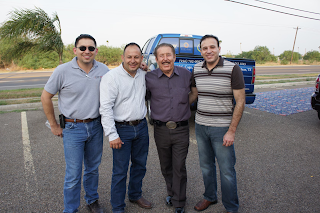
Birthfather with his father and brothers
It took me about a month of sifting and message-sending to various DNA-related people until I got a response from the son of one of the people I'd messaged.  We had a good long talk and he filled me in on the greater family history.  The family was originally located in Neuvo Leon in Mexico. Over time, some folks moved north of the current border of Texas and some did not.  They were all descended from Spanish settlers who settled the area and typically intermarried with other Spaniards and tended to have lighter complexions.  I got a lot more history, but I still was stalled out on the hunt. This cousin providing the information knew of the line I was looking for, but did not know much else. Four months passed with no progress.

Sometimes, I count on what I call my "spidey senses" to figure out a problem. That little signal that shoots through me when I'm sure I'm onto something. One day, while searching the same search terms for the twentieth time, my spidey sense started to tingle.

I ran across an article about a man with the name I was looking for. Then I saw his photo and I saw my son in his face.  That was totally weird.  Let me tell you.

I hunted down an email for his business and sent a short note along with some photos of when the birthfather was a young man. I heard back from his niece, who works for him.  She played go-between for the next few emails. He took a DNA test and all was confirmed. I never spoke to him myself, but was able to connect he and my son and a fledgling relationship began. 

They texted for months. Then birthfather visited. Then a half-brother visited. Then my son and his family went to his half-sister's quinceniera where he met his biological grandparents, siblings, aunts, uncles, and his birthfather's wife. They felt welcomed and loved. Their relationship continues. I am thrilled for him.

My son is very close to his father, the man who raised him. But, it's got to be kind of weird for him. I hope my ex realizes my son doesn't want to replace him, but needs this relationship. My son is a little weirded out that his birthfather never asks any questions about his childhood or if he was happy. I found that comical since my son is never one to ask any extra questions or share his feelings without something quite compelling driving him to do so. 

They walk the same. They both pass out when they see a needle or blood. Their bodies are shaped the same and they share the same nose and dimples and the cleft in his chin. It's fascinating to watch. Somehow, my son is finding space in his life and his heart to fit in a passle of new siblings, another set of parents, while still keeping those of us who've known him his whole life close.  I'm pretty proud of him.


Friday, January 1, 2021

Smith Family: Madge Smith Scoles

 Jacob Smith > William Custer Smith > Edwin Smith > Madge Smith Scoles


Madge Smith was the fourth living child and second daughter of Edwin Smith & Kate Smull Smith. She was born 17 Jun 1897 in Bremer County, Iowa. When just about 23, she married Glenn Wesley Scoles, son of James Francis "Frank" Scoles and Ada Mae "Eda" Tracy on 19 Apr 1920 in Waverly, Iowa. We have another Scoles connection through Edwin's brother Walter. Walter's daughter Minnie married Charles Alfred Scoles, brother of Frank Scoles listed above.

Madge and Glenn farmed outside of Nashua, just down the road from the family "home town" of
Plainfield. They had nine children, all now deceased.

Beverly Bethel Scoles: b 24 Nov 20 and d. 30 Nov 1920 in Butler County.

Jeanette Scoles (Twin):  b. 07 Nov 1921in Butler County d. 28 Aug 2004 in New Hampton, Chickasaw County. She married (1) Harry Bradshaw, whose amazing story is here, 04 May 1941 in Toledo, Tama County; and (2) John Zobeck in 1948.

Annette Scoles (Twin): b. 07 Nov 1921 in Butler County d. 03 Mar 2002, Louisville, Jefferson, Kentucky. She married (1) Clifford Valentine Querry about early Jan 1946 but was divorced in Seattle in 1948. Cliff was a Navy man and was on the ill-fated USS Lexington in 1942, but survived; and (2) Melvin Jennings was also a Navy man. He remarried after Annette's death.

Conrad Wesley Scoles: b. 02 Jan 1924 d. 07 Jan 1924 Chickasaw County.

Audrey Gail Scoles

Richard Henry "Dickey" Scoles: b. 28 Apr 1925 d. 13 Dec 2006 Nashua, Chickasaw County. Married Frances D Nehls, 05 Jan 1949, Nashua, Chickasaw County. Early on, he worked for Oliver Co. and then he worked for the railroad for nine years as a section crew worker until the railroad started reducing crews. He then worked as a lathe operator at Hydrotile in Nashua and later for H & H Tool & Die in Cedar Falls until he retired.

Audrey Gail Scoles: b. 03 Jul 1926 d. 27 Jul 1987 DuBois, Clearfield, Pennsylvania. Married Harry Ellsworth Shaffer, Sr. Harry was a career Navy man and they settled in his hometown. I recently connected with two of Audrey's sons. We've also discovered a son born prior to the marriage to Harry Shaffer who was adopted in Iowa. That's a tale for another day.  

Wendell Edwin Scoles: b. 24 Jan 1928 d. 01 Aug 1987 Nashua, Chickasaw County. Married Sharon Juel Reazak, 05 Feb 1949, at the Little Brown Church in Nashua, Chickasaw County. At the time of his marriage, he worked at the Capitol Tobacco Co in Charles City.  He went to linotype school and worked for the Nashua Reporter as a typesetter. Wendell served in the Navy, enlisting 10 Apr 1945 and discharged 25 Jun 1946.

Burrdette "Bucky" Howard Scoles: b. 26 Mar 1929, Bradford, Chickasaw County d. 17 Sep 1977
Harry E Shaffer

Des Moines, Polk, Iowa. Married Mitsue Miyashiro. Buck was a career Navy man who died while still in service at the Des Moines Veteran's Hospital.

Service Dates:
Enlistment: 01 Jun 1946 Discharge: 04 Mar 1948
Enlistment: 17 Feb 1950 Discharge: 09 Feb 1953
Enlistment: 18 May 1955 Discharge: 17 Sep 1977

Ronald Glenn Scoles: b. 15 Aug 1930 d. 28 Sep 2007 Charles City, Floyd County. Ron lived with his mom until her death and never married. He is buried without a monument at Willow Lawn Cemetery in Plainfield.